Council Preview
By John Swartz
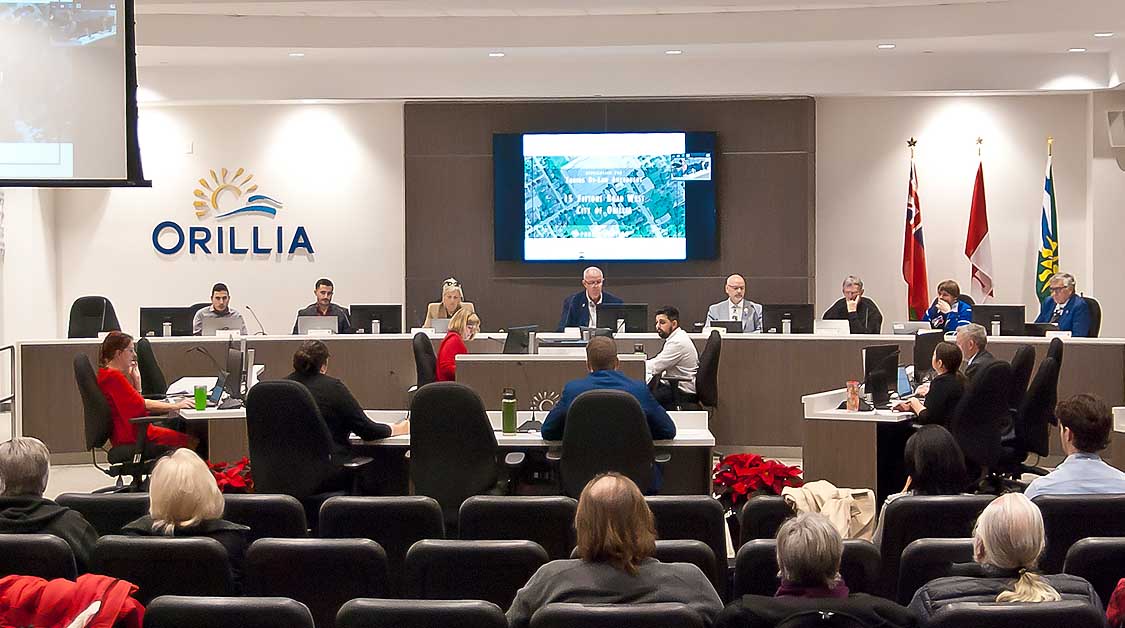
Orillia council’s meeting September 28 starts early at 12:45 p.m. to accommodate two additional special meetings. Under the vagaries of government, meetings to deal with things like planning matters, tax write-offs, and a lot of other things, have to be held as distinct entities.
So the council meeting will start, adjourn, and then the tax appeals meeting will be called to order. Just shy of $10K is being written off, in all cases due to buildings being demolished. In the last few years the locations and owners of the properties have not been part of the document, just a tax role number.
When that meeting ends (it will take about 15 minutes) the planning meeting starts.
The discussion will be about amendments to the zoning by-law. From time to time staff notice things in the by-law that aren’t needed any longer, were not worded well enough to be understood a few years later, or have other errors.
In this case, several points in the by-law are being adjusted to agree with other City policies, or changes in provincial legislation. One of the more interesting ones is to apply a fairly large holding provision prohibiting further development (how does this affect the high rise Airbnb planned for Atherley Road isn’t mentioned) on properties on Couchiching Point and Orchard Point because the Couchiching Point sewage pumping station is at capacity. Holding provisions on development are usually used to require additional studies or additional construction requirements, and prove before a shovel hits the ground concerns have been addressed. In this case any new development has to prove that development won’t negatively affect the pumping station and waste water capacity. Who didn’t see this coming; squeezing in as many condos in a neighbourhood of single family housing to the degree which happened over the last ten years has to have some kind of downside, wouldn’t it?
Of course, expanding capacity would, in-part, be the responsibility of developers to pay for with development charges, but also of course, the province demanded municipalities reduce the amounts they can charge developers – in Orillia’s case, by 50%. So, any expansion will be paid for by you.
Several definitions are being changed to make them clearer things like duplex, dwelling, open space landscape, and etc. It is likely pressure from the province on municipalities to allow denser housing (which Orillia has already changed) is forcing a more rigged definition of what constitutes certain types of housing.
At the same time several definitions are being added. Things like boardwalk, permeable material and driveway entrance apron, need to be added.
A thing most people wonder why it’s being changed is renaming sight triangles to daylight triangles. It seems engineers – everywhere – were feeling left out of municipal reports and changed something we all could understand immediately to something new – just because. One wonders if anyone pointed out the new name doesn’t work for half the day.
The number of parking spaces for long term care facilities are proposed to be reduced. One wonders how that’s going to work since at roads by long term care places in the north end are basically parking lots now because there isn’t enough parking in the small lots at those places.
Long term care facilities are being added to permitted property uses in several residential and commercial zones.
Also, the province, in its infinite wisdom legislated municipalities cannot require electric vehicle charging parking places in new development. So, the City has to remove that wording from the zoning by-law.
Regular Meeting
When the planning meeting ends and the regular meeting starts council will go directly to the public forum because there are no deputations or presentations on the agenda. Then council will have a closed session to deal with two items. One is regarding the federal government’s build communities strong fund. A guess is it is to decide to tell staff which projects to use in applications for funding. The second item is an offer to buy City land. What land? Who knows.
Back in public, a report from Councillor Whitney Smith contains, among other things a paragraph asking the province to “develop and adequately fund a coordinated provincial physician recruitment and retention strategy that builds upon successful local initiatives, reduces the financial burden on municipal taxpayers, and addresses the increasing competition among Ontario municipalities for physician recruitment.”
This is necessary because of the silly state of healthcare in Ontario and the case which pits communities against each other to get doctors and graduates to set up shop in their places – all at the cost of dinging the property tax levy. Obviously some communities put more money into their efforts and the idea of setting up inducements, which in some cases could be viewed as bribes, to get doctors to practice in their municipality is a waste of time, money and effort for something which should not exist, if not for mismanagement of healthcare by the province.
It’s Not That You Stop, But Where You Stop That Matters
Following from a request for an all-way stop at Canice and Jarvis Streets (staff are not recommending to do so), staff are asking for permission to make some changes. Apparently the stop bars (lines on the road, are not in the best place or fit MTO guidelines, and they want to move them. Also there is a tree at the corner which is obstructing the view and they would like the ability to trim or remove.
So, What Did We Get?
In light of the donation made by Gordon Lightfoot’s estate of a 24 foot trailer full of items the City received last week, a report from the Lightfoot working group is asking for a $100K budget to cover the cost of appraising, documenting, and cataloguing those things.

The motion also formally accepts the donation. This is necessary because legislation at other levels of government require municipally owned museum assume responsibility of items be cared for properly.
The motion also dissolves the reworking group because the intent of the group was work on acquiring as much of the estate as possible and this has been done. Some of Gord’s items donated were put up for auction and did not have buyers. Someone previously bought many items in the auctions and donated them to the Orillia Museum of Art and history, so it’s safe to assume as much of Gord’s things to acquire has been accomplished.
The report states much of the budget can be accommodated within the 2026 budget, whether that is from the general operating budget or specifically from OMAH’s budget is not stated. The motion also says if there is any deficit in the budget because of this expense fund form the tax rate stabilization reserve be used to balance the books.
Counting Beans
The Downtown Orillia Business Improvement Area wants o take back control of its finances from the City and use the firm, Debits and Credits, to manage its books. Debits and credits is a generic enough term finding out anything about this company looks like a day-long affair.
Property owners in downtown Orillia pay an extra tax which the City collects and pays out to the BIA. That won’t change. Almost all other aspects, preparing balance sheets, budgeting, handling payroll, and etc. are part of the City’s operating budget and those costs would shift to the BIA.
Staff state they approve in principal of the plan, but want some more detail about some items regarding the transition and how accounting will occur. Staff also say costs attributed to the BIA by the City will fall by about $11K.
We’re Tired Of This
Getting rid of tires is about to become an issue for residents. The province changed regulations to require producers to operate a used tire collection system, which producers found to be too expensive and contracted collection systems. The province does not require municipalities to collect tires, but if they do there are restrictions on off loading them in the same manner as producers have regarding how much can be accepted and carted away.
This has lead to cases, of which Orillia is experiencing, of stockpiles of used tires and not being able to ship them out is sufficient quantities. Staff want permission to write the province asking for changes in regulations. Producers have already done so, but the province has ignored requests so far.
Therefore beginning October 1 staff want to limit residents to 4 tires per month to be accepted at the landfill. This is traditionally the time of year people get rid of used tires, and also a time of year when commercial establishments get rid of a higher volume of used tires.
Part of the problem is commercial deliveries of tires are limited to 10 tires per day, and some business have been finding creative ways around that restriction. Staff say there are 5,000 tires currently on site and there is no indication anyone is coming to take them away, and that if expected seasonal volumes of used tires happens a number of storage issues will be stretched. Aside from space, a fire hazard is compounded by having that number of tires waiting to be taken away.
Do We Have Any Money Left?
That is a question jokingly asked of the City’s treasurer from time to time. On that note the 2025 audited consolidated financial statement, is on the agenda for council. Highlights are: despite a deficit in the development charge reserve, overall reserves are up but $17 million to $127 million; long term debt fell by $2.4 million to $36.7 million; the City has $150 million of net financial assets (the City has $193 million in investments on the books).
Still on finance, but specifically the 2026 budget, staff have a quarterly report on how sending is going. Of note, costs to deal with flooding in the spring were $109K, and they are pursuing grants to cover the extra expense.
The motion to accept the report also includes budget increases to a traffic calming project and traffic signals at Swinimer Drive and University Avenue in the amount of $16.6K. That is balanced against 12 completed capital projects in the budget year that were under spent by $1.5 million.
First thing We Do, Something, Something… Lawyers
Staff are recommending to council set up a legal and risk management reserve fund. This does a few things: legal fees are currently funded as capital projects from the operating budget on an as needed basis; setting up a reserve creates a specific place for anyone interested in knowing how much legal actions are costing taxpayers; litigations typically last longer than budget years and covering the costs from a dedicated reserve means not having to assess operating budget requirements every year; it also allows for retention of allocated funds unspent in a more efficient manner.
Currently any unspent budget allocations generally get transferred to one or two reserve accounts of a general nature, by funding and paying for legal costs out a dedicated reserve, any unspent allocation stays in that reserve.
This move will not affect the current tax levy and $252,309 of current budget allocations (unspent) will be transferred to the new reserve.
Rigging, But Not That Kind
The Opera House’s rigging system failed September 9 affecting the ability to raise and lower backdrops and lighting on stage, and in turn affecting scheduled productions.
The main signal processor is the culprit and fixing it also means replacing some downstream components because the system is 30 years old and compatibility of old parts with new is an issue. The cost do fix things is $73K and staff recommend funding from the Opera House reserve.
Reservations Pending
Correspondence related to a conditional site plan approval to Jayantilal Panchal for building a five-storey, 96-room Holiday Inn Express at 849 West Ridge Boulevard. (Councillor Jay Fallis pulled from a council information package for staff direction). The issue is a report on traffic affects. Fallis wants another staff report on results of a study.
Council meetings are open to the public or can be watched on the City’s Youtube channel.
(Photos by Swartz – SUNonline/Orillia)