Look Who Is Back
By John Swartz
As with every election, SUNonline/Orillia profiles candidates for office. In the case of holding the mayor’s office in Orillia, this leadership position is different than those of council. Despite having an equal vote most of the time, being the leader of council and therefore the community along with some responsibilities beyond those of other council members, raises the significance to a level a profile is warranted.
Each candidate was contacted by email with an outline of the discussion so voters could compare answers. They participated a sit down discussion of the same issues generally being talked about and issues we feel should be talked about.
Steve Clarke came to Orillia to start a business, which quickly became an institution.
“I grew up in the Midland/Port McNichol area, then I went away to Southwestern Ontario. I went to school in Guelph (geography and human kinetics), then ended up taking food administration courses and I started getting into the food business. Then we (with wife, Chris) started looking for a place to locate our own business because I was running a restaurant for another company and they wanted me to go to Winnipeg and start opening up restaurants all the way out to Victoria.”
“Right after university I was at McDonald’s running one of their places and going to Hamburger University in Chicago; I know it sounds funny. Then I joined the Kelsey’s chain and ran one of those for about three and a half years in London.”
“We had a space inside and on the roof about 280 and I could have thrown a ball into the Ceeps (a relatively infamous place Western students occupied daily).
“Then I decided to open up my own place. We went to London, Kitchener, Guelph, Stratford, Midland and either couldn’t afford what we saw or didn’t like what we saw. One day Chris was looking through the newspaper and saw a restaurant for sale in Orillia and honest to God a light bulb went off, it just seemed to make sense. It was bigger than Midland, but I knew the area, I used to play my high school sports against Orillia. We got in the car the next day and the place that was for sale was Reggie’s Sandwich Factory. I didn’t like the layout and right down the street was Brewery Bay. It was in a state of disgusting repair, but I fell in love with it.”
Clarke also said the view down the street to the lake and the heritage atmosphere was also what attracted him to Orillia. He retired from the restaurant in 2025 and has been working part-time for the province since.
“I work on a tribunal, I do mediation and adjudication for various types of license appeals.”
To answer why he is running for mayor now Clarke goes back to why he chose to run in 2013 to set up why he wants a third term.
“The first time I ran there were a number of things I wanted to accomplish, including moving the rec center forward, the climate change action plan – I wanted to get that going. And then the second time I ran was to help finish off the things we had initiated, including the Hydro One deal, which wasn’t solidified at that point. I ran a second time to make sure the rec center got opened, with council’s support of course, and to bring Hydro One to town. When I accomplished that I felt I should be able to stand away and let somebody else take over.”
Did Chris say, ‘you’ve got to find something to do, you’re around the house too much?’ After a chuckle Clarke said there were a few things on the horizon he thinks are important and he wants to be in a position to make sure they happen.
We need to build a new hospital, so I’m excited to help steer the new hospital forward. That leaves the two other projects. One is how do we maximized the opportunities for Lakehead to realize the synergies with the hospital; what can I do in terms of programming to benefit and prepare people to work at the hospital, which will also bring more students to town, which helps Lakehead grow. I want Lakehead to realize the growth that they want in Orillia and I think Orillia certainly benefits economically and culturally. I want to help make sure the hospital goes in the right direction and the shovel gets in the ground. The other big part of the equation is what do we do with the existing hospital? We did a report in 2020 and that report came back to council and said moving that hospital to the West Ridge along with their 1500 employees will have a negative effect on the businesses in the core of the City, they will lose about 10% of their volume, which for some of the businesses is make or break.”
“So what we do with that property is vital. I know there have been some preliminary conversations with the hospital on what that might look like. My hope is the hospital will retain certain health hospital services at the tower. The tower is only 20 years old. That would be good and keep a good employment base there. The rest of the property, I’m not sure what the plan will end up looking like. It may be affordable housing. There’s nine and a half acres there that will help mitigate the effect of moving the hospital. So the hospital, Lakehead, the existing site of the hospital, but also the redevelopment of the downtown. What attracted Chris and I to Orillia was the downtown, the trees, the heritage look and the redevelopment went through last time is almost 50 years old and it’s starting to look like it.”
He is also excited about another project happening in the City, but which the municipality has little to do with, for now.
“What the OPP are doing on the HRC property, its happening, a training facility for the whole province. I think they already have something like 2,000 employees in the community, and there’s going to be more.”
Champlain Monument
All candidates in this municipal election were asked for their positions regarding the monument. The context of the question was, so many make emotional arguments for returning it to its place and for not doing so. There are historical reasons, which SUNonline/Orillia has written about, which paint a very different picture of Champlain than conventional wisdom views. We wanted to know if those running for office had anything beyond the emotional argument for their position.
“I would work with our friends in Rama. I do believe Champlain should come back, but with an equal representation of the Huron-Wendat. I also think it’s absolutely necessary to put up educational interpretive pieces, a full history of our indigenous people and a full history of colonialism.”
Clarke compares to his experience seeing Auschwitz and he won’t talk about some of what he saw and learned. Coincidently he did an interview about Champlain that would be broadcast nationally while at one of the concentration camps. He learned 2 million people visit every year and if they had bulldozed the camps there would be no reason to go there and nothing to learn. The are parallels and he recalls the steps the committee during his last term encountered.
“We’d all agreed to bring it back, but bring it back with educational interpretation so we told the whole spirit and story of our indigenous past and colonialism. And then of course I got a call from my friend in Rama and he said – Steve we just found those bodies and my community is quite upset and we just can’t be a part of this at this time, we’re not telling you what to do, but we can’t be a part of it – and I fully respected that and we pulled the plug on moving it forward at that time.”
“My point is to not do anything, I went to high school with people from Beausoleil First Nation, but my knowledge of our indigenous history in this area was virtually nil. We need opportunities to have that education. I sent a letter to premier Ford asking him to incorporate indigenous history into the curriculum. We need those education pieces. I still maintain an empty field tells us nothing. It needs to be active, it needs to be the good, the bad and the ugly. It needs to be accurate. This is a complex issue that will take time.”
Homelessness
Before the nomination period closed the talk of the town was the monument. However another topic has since become the central point of discussion. It has become of such importance the topic of homelessness was almost the central theme of the candidate’s night at St. Paul’s Centre a couple weeks ago and Champlain only came up once near the end of the night.
Homelessness didn’t just happen, it took years of planning, or rather the by-product of homelessness took years of economic planning to hand over control of our lives to corporations and indifference of the consequences at both provincial and federal levels of government. We are reaping what was sowed so long ago and now the finger pointing is rampant – and it is most often pointed at the homeless as if they caused their circumstances and therefore if they simply got jobs all their troubles would be solved.
Only this year did the feds get back in the game of funding housing, and the province is content with housing start targets with some minor compensation to municipalities for taking away some of their planning and zoning controls. Both higher levels of government pushed the responsibility for housing down the chain. The problem is with the causes being at higher levels and municipalities being what they are, the entity least able to even tackle, or solve as some believe, the City is the organization with the least resources to do so.
So, how does a mayor, or council do anything substantial and lasting, or is the best approach to force higher levels of government to act by constant pressure to change policy? And how does one do that?
“The City of Orillia is responsible for roads, sidewalks, water, waste water, parks we have core responsibilities, that’s what our tax base is supposed to go for. Because of downloading and increasing level of issues such as homelessness, we can no longer sit back and say County of Simcoe we can give $8 million dollars a year to take care of our social services and ambulance; we can’t do that anymore because that’s not enough. The problem is far exceeding their resources we give them and what the province is giving them, we need to continue to lobby the feds and the province and that’s through AMO ( Association of Municipalities of Ontario) and band together and try to get more adequate resources, predominantly for affordable housing, but also for addiction work and mental health.’
‘Number two is, what I plan on doing, because I know the lead cause of homelessness is not having a roof over your head, a lack of affordable shelter, and I don’t want to step on the toes of anything being done now, but when I was mayor last time there were not many things going on in Ontario where they were making a meaningful dent in the level of homelessness, and since the pandemic started it’s 50% worse than it was before the pandemic. I hear solutions (As Barrie is doing), if it works it works, but I know you are not necessarily allowed to break up these encampments unless you’ve got a place to put them. There’s also been a suggestion that people on drugs, you pick them up and force them into treatment; if you take somebody off the street and force them into a program the recidivism is 98% so what the heck have you done?”
Some places have done things that work, Scandinavian countries for example and Finland in particular. Does some of the inspiration for action come from off-shore?
‘Within 45 days of taking office I will put a task force together and it will be charged with looking around Ontario, Canada, the U.S., Europe, or wherever, wherever they have had a meaningful difference in reducing homelessness, mitigating addictions and mental health and where they have improved community safety and including meaningful things they have done to increase the inventory of affordable housing.”
“It can be an investment. If somebody is incarcerated it is over $100,000 a year to keep them there, if you put them into a shelter or transitional housing I believe the cost is $20,000 a year.”
“If they cross the line, if they are doing anything unlawful they need to be picked up and face the judicial system. But a lot of the calls the OPP get are for addictions or mental health.”
Strong Mayor Power
This is an issue entirely made up to solve a problem many see didn’t exist. Many people believe a mayor doesn’t not need more power. Some strong mayor powers can be returned to council, as a mayor is that something you would do?
“I was opposed to Strong Mayor Powers even though I was not on council when they were offered to municipalities. I was mayor when there was a pandemic and there are emergency laws that kick into place during a state of emergency. We met 400 times during the pandemic and we met with different departments to make sure we had continuity of operations. We had the flexibility to do what we needed to do to take care of the city, so I don’t understand why strong mayor powers are needed.”
“I understand they are mandated to be used for the budget process, so what I am going to do is use them to include members of council on the budget committee to put the budget together. I have no intention of using them for the rest of the term. I have no desire or inclination to use them in any way, shape or form for four years. I can’t imagine the scenario, we already faced a state of emergency situation and we had the tools we needed, so I don’t understand the need, I really don’t.”
The New Hospital
It seems an uphill battle to get the Soldiers’ Memorial board to reconsider their chosen location for a new hospital, despite all the caveats, drawbacks and yet to be revealed costs to the municipality, tax payers and businesses to be balanced against the beneficial reasons for locating in the West Ridge next to Lakehead University is moot.
We have some idea of what some of it will cost the community, costs that won’t be on the hospital’s books, but the duration and spinoff effects have yet to be investigated.
“Like many others I really wanted to see the hospital built in situ, or somewhere in the core of the City. We had 18 or 19 acres, then the need became 25 for whatever reason. Where I am now, I would have preferred a different location, but now this decision has been made, now the province is in support, now that there’s this opportunity with Lakehead I am fully in support of moving the hospital and getting a shovel in the ground as fast as possible at Lakehead. If something thwarts that it would be a different discussion.”
“I’m looking forward to supporting Lakehead’s expansion which will come with the help of the property purchase by the hospital and moving them to stage two with the province as soon as possible. As much as I would have preferred it here before, that ship has sailed and my efforts will be in West Ridge. Having said that, I want to make sure there is protection for the City that the money Lakehead gets from the sale of the property goes to expansion of Lakehead in Orillia and my understanding is Lakehead is quite amenable to that. I don’t think that’s an issue, and I also want to make sure if the hospital gets that property they put the shovel in the ground. If not, somewhere down the road that property needs to come back to the City.”
But what if Lakehead doesn’t do what they promise and expand in Barrie as they have already done.
“You will recall when I was on council before, Mayor Lehman fought tenaciously to have Laurentian University brought to Barrie and that got to be a real issue because many of us believe if Laurentian ended up in Barrie, Lakehead would be in a precarious viability situation, and I still believe that would have been true. Some of us went to Queen’s Park to fight against. In the end we won.”
“As long as there isn’t a university presence there, there is always the threat a university will come there, so I commend what Lakehead just did (opening up a campus in Barrie). I do know for a fact Lakehead’s expansion plans, they want to see their main expansion occur in Orillia.”
How The Municipality Operates
Municipalities operate according to codes and by-laws, which staff then take as chiseled in stone. If your situation does not fit, your answer is no because the book does not say staff can say yes. However there are large organizations that operate on practices, which are more nimble and can accommodate occurrences not thought of a the time of writing and can be adjusted quickly for once in a life time events without abandoning the practice.
A case in point is what happened to Sweet Dreams Ice Cream during the reconstruction of Centennial (Lightfoot) Drive. Access to their business would be non-existent. They have operated in Centennial Park for events for years on a temporary basis and came up with a plan to move to their usual location in the park for the duration of construction. Well, nothing in the zoning or by-laws would permit that and staff came up with many ways to say no, including if council said yes it would set a precedent and everyone else would want the same thing, rather than find a way to say yes. Then council, instead of saying – this is unlikely to ever happen again so we’ll make an exception – sided with staff. Every one turned a blind eye to the loss of business awarded to a long standing business member of the community because there was policy.
So the question is, is there merit to adopting practices and being flexible to unusual events and occurrences?
“I was a business person, I could pivot where I wanted in 24 hours. Usually I would consult my staff and even my customers. When you are using public dollars, you’ve got to make sure everybody is being treated fairly. Those policies need to be fair and apply to the vast majority of situations. That doesn’t mean exceptions won’t come every once in a while, when they do, those can still come to council.”
“Once council sets policy, staff has really have no discretion implementing that. What staff can do, and what the public can do is get a hold of a member of your council and say can you bring this to council for special consideration. There are situations it just makes sense to do something. You do have to consider the precedent it sets, it could open the floodgates, sometimes it won’t.”
Staff also amalgamated several committees of council into four working groups. Some of those committees lumped together have thin relationships with each other and the net effect is there are now fewer people sitting on committees advising council. Will this change?
“I think the next council needs to sit down with senior staff and look at the setup and composition (of working groups/committees)”
“Council makes the decisions, staff enact. That’s the beginning and the end of it. That doesn’t mean we don’t take advice from staff, many are professionals so we need to consider it. If council wants to edit that report or change direction, staff has to abide by that. That’s exactly how that works.”
The Downtown
For a very long time council has treated the downtown as if it is one big collective taxpayer, just like any other taxpayer. But it is not. It is the heart of our City. If the heart gets sick, the whole city suffers. Communities have died because they neglected their downtowns. Not that Orillia has neglected, but council sure has made the merchants jump through hoops to get decent municipal service. ‘
For example, ours is the only downtown this writer has experienced that allows snow drifts to stand for days and weeks downtown and every time the BIA asks for something to be done, the first question from council is, ‘how much are you going to pay for this?’ Yet the question is never asked of Memorial Avenue businesses when that street gets plowed many times during and after storms. The city just does it and builds the cost into its budget.
The amount of weed growth downtown is embarrassing, but if anything is to be done the BIA has to pay for it, which ignores the fact it reflects on every resident of the City.
The bottom line is the BIA has to go to council hat in hand every time something needs to be done and the City continually says, – not our problem. Snow removal is a constant issue.
Should council be changing its attitude toward the downtown?
“Snow clearing is done on a priority basis. The arterial roads need to be done. If we are getting snow day after day it’s tough for them to do snow clearing. As soon as it stops, that’s when you start doing snow haulage.”
“The last two winters, I feel sorry for the winter operations people, but if that’s going to become the norm, then we need to prepare for that and that’s partly what the new budget is going to contemplate.”
Then there is Mayor McIsaac changing the budget for road reconstruction downtown from $50 million to $18 million by eliminating work on the cross streets to Mississaga Street and pushing back on the BIA asking for a study of what is underground before doing much more. This seems to be missing the point of the connections in the core and to the City as a whole.
“It cannot be a short-term solution. You can’t be just putting a band aid on it that has a short ten or fifteen year lifespan, especially when you’ve got to contemplate what’s going under the ground. The side streets need to be done, they are just as vital to the downtown as the main street.”
“What we do with the downtown is going to, it could make or break the City. Remember George Dark from Urban Strategies (stickhandled developing the Downtown Tomorrow Plan), he came with a wealth of experience and his line was, ‘you can’t have a healthy apple without a healthy core.’ Downtown redevelopment needs to happen in such a way that’s not just putting new asphalt down and planting a few trees. That’s just not going to do it.”
“When we redevelop the downtown it needs to be done in a wholesome way that truly is good for the next 40 or 50 years, not for the next 15 or 20.”
“It needs to inspire people to come from West Ridge, but it also needs to inspire people to come north and south on Highway 11 and come to the downtown. West Orillia, especially with the new industrial park employment lands we have we can attract new businesses with; I believe the west side of the city is going to do very well. We need to do two things. We need to bring people from West Ridge downtown and we need people from downtown to know they can get to West Ridge fairly easily. What’s starting to happen is people are starting to see a West Orillia, or an East Orillia, new and old, there’s only one Orillia, the Sunshine City.”
Climate Change And The Municipality
One gets the sense the City’s climate change action plan is not in the front seat at the moment. As mayor will you continue to put focus on the City being the leader for the rest of us in taking steps to combat climate change?
“I brought it to council and that was one of my proudest moments as mayor. It’s not just because it’s close to my heart, but it’s absolutely necessary. We’re experiencing storms we used to get every 20 to 25 years every couple years. You saw the ice storm a year and a half ago. Three or four weeks ago I drove through rain and hail on the way to Toronto and I’ve never driven through conditions like that in my life. That’s’ what we are experiencing. We’re seeing more heat days, record snow falls because Georgian Bay isn’t freezing. The climate change action plan has to talk about adaptation and mitigation and I am looking forward to diving back into that.”
Religion
This topic is driven by Whitney Smith. Early on in the election period she made and posted some videos that had many people upset about her use of religion and worried it would influence the office. So the question is, should there be a clear separation of church and state in municipal affairs?
“I believe many religions have some good values that all citizens could benefit from, e.g. living by the Golden Rule! However, I believe religion and City Hall should be kept separate as a council represents everyone in the community.”
The Last Word
Being pressed for time, unfortunately Clarke’s last word was a euphemistic – I gotta go. He didn’t say that, but he did say at the outset he had a time limit, so the opportunity was missed to give him a chance to expound on anything not covered by the questions posed.
Casting Your Vote
Election Day is October 26 and polling stations are open from 10 a.m. to 8 p.m. at the following locations:
Ward 1 at the Gill Street community Complex
Ward 2 at the Orillia Recreation Centre
Ward 3 at the West Orillia sports Complex
Ward 4 Simcoe County Community Hub, 250 West Street North
Mayoral Candidate Whitney Smith
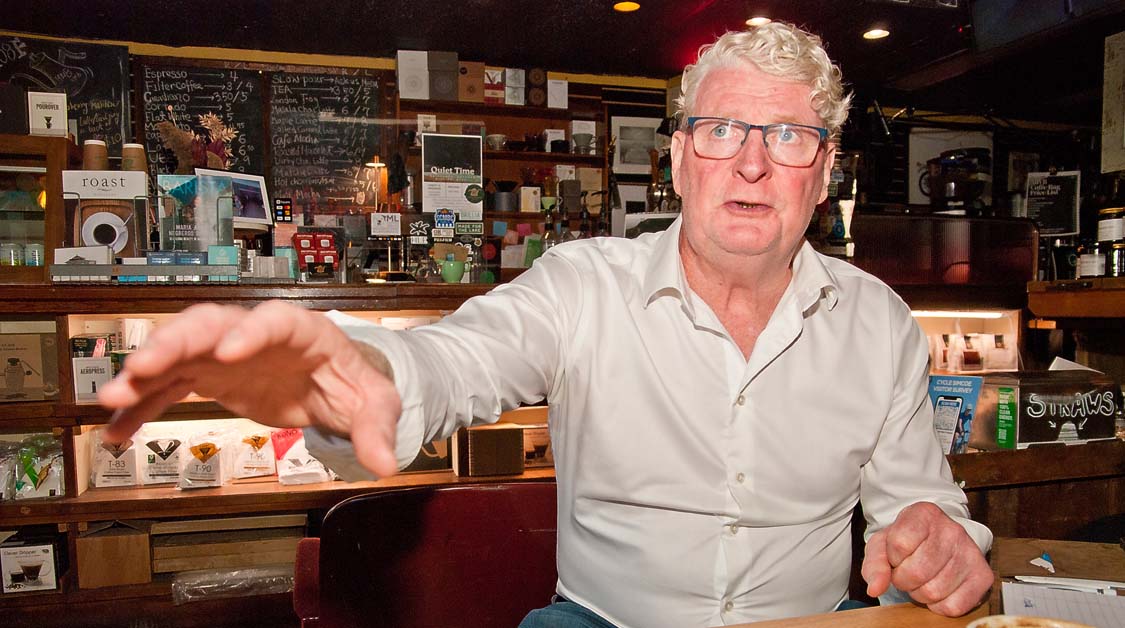
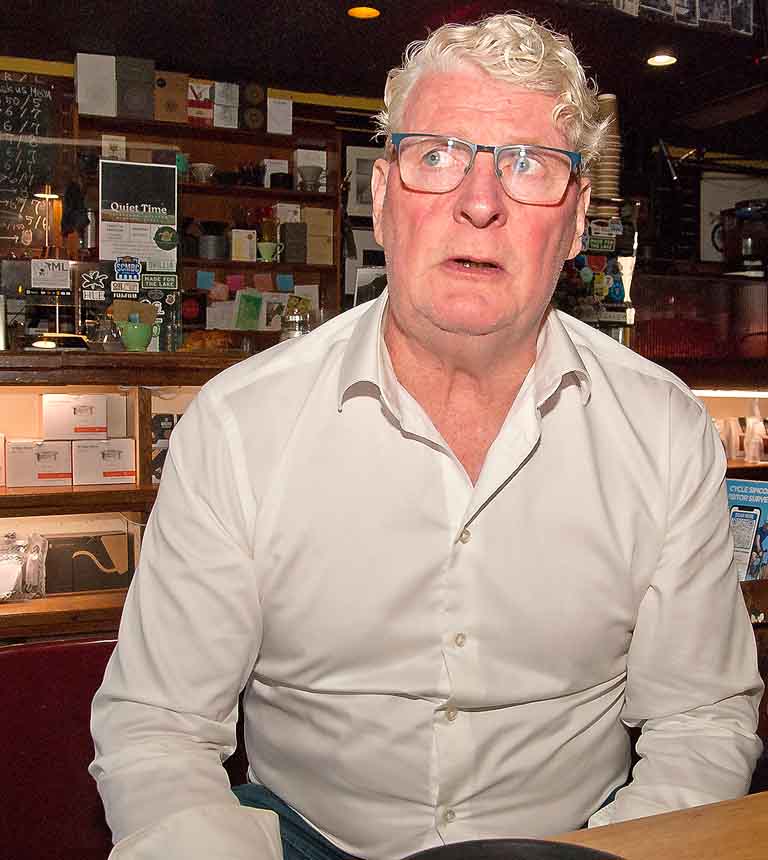
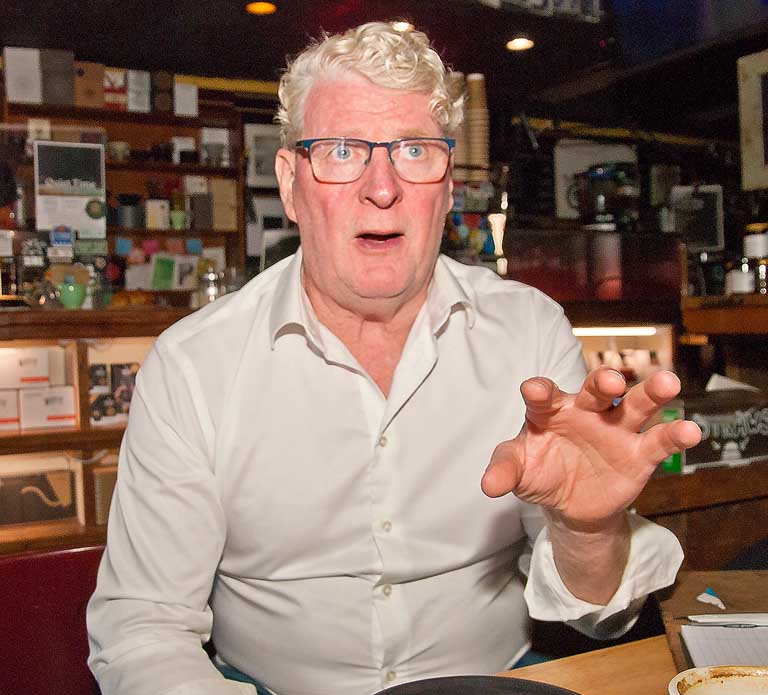
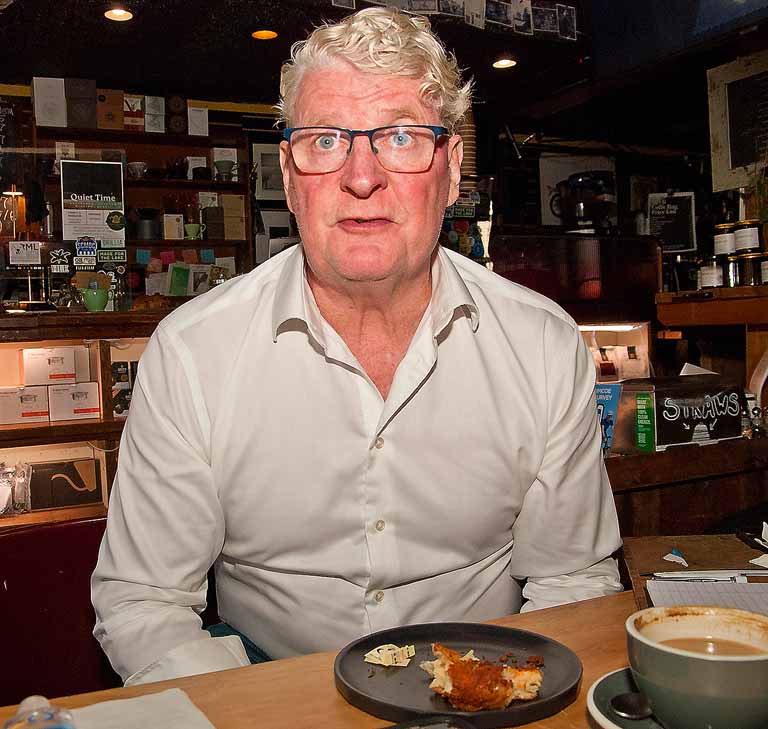
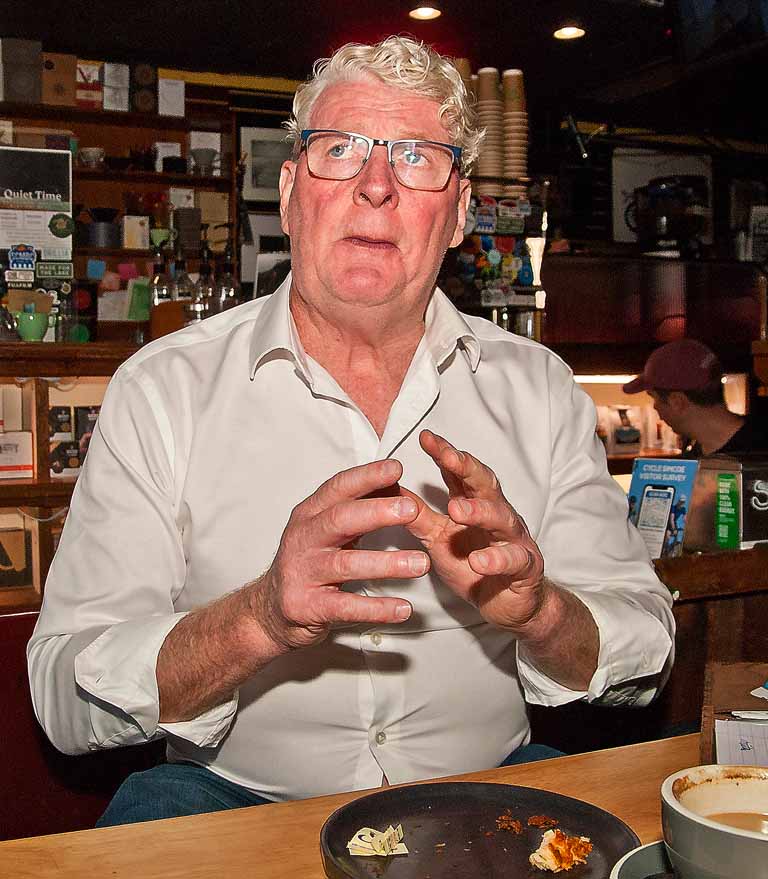
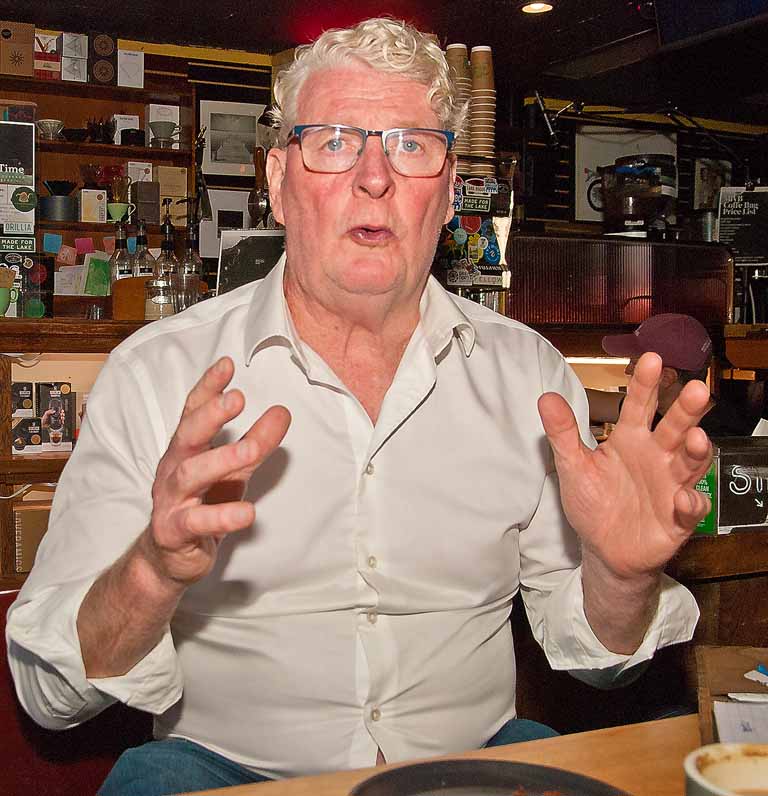
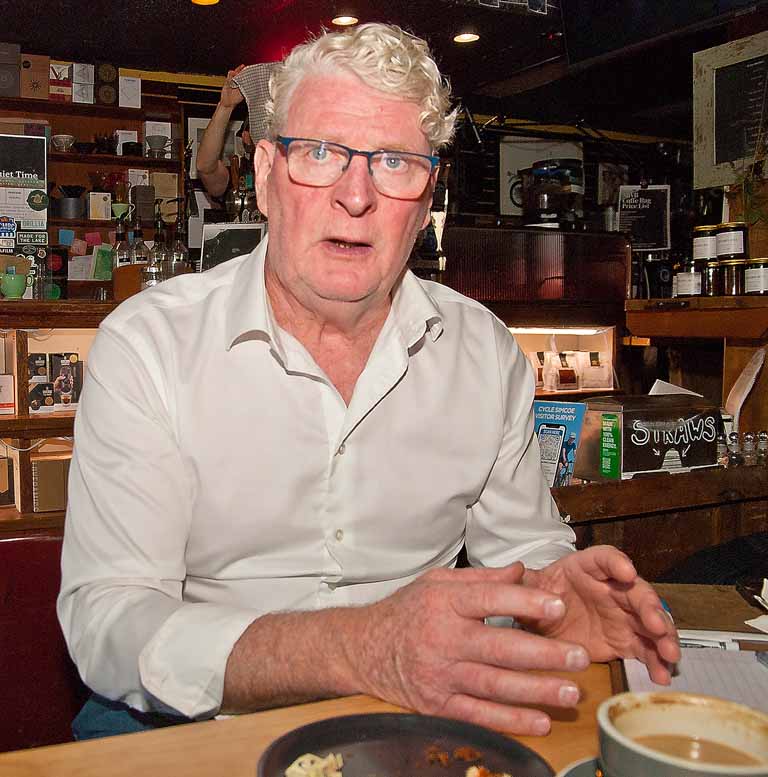
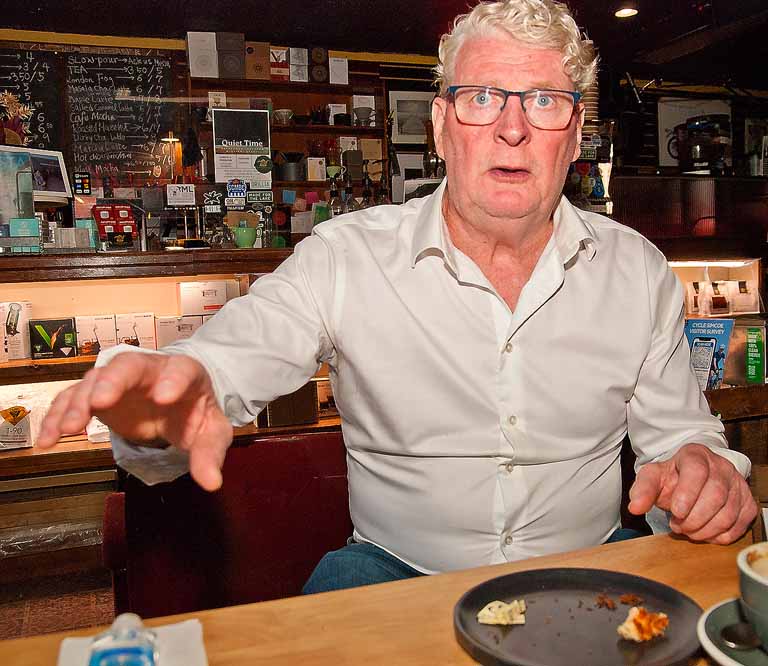
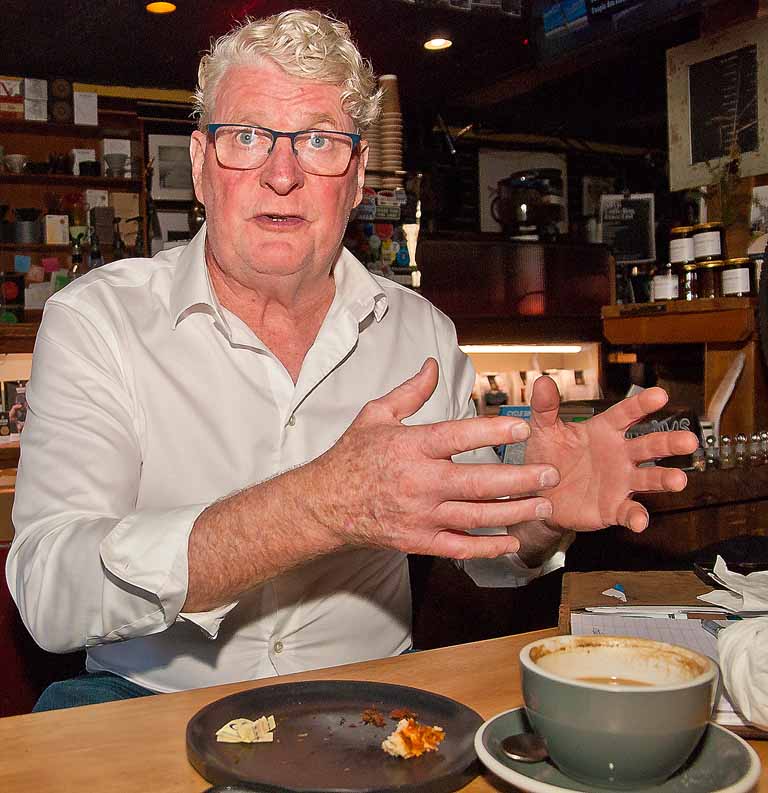
(Photos by Swartz – SUNonline/Orillia) Main: Steve Clarke is asking for a third term as Orillia’s mayor.