
Council Preview
By John Swartz
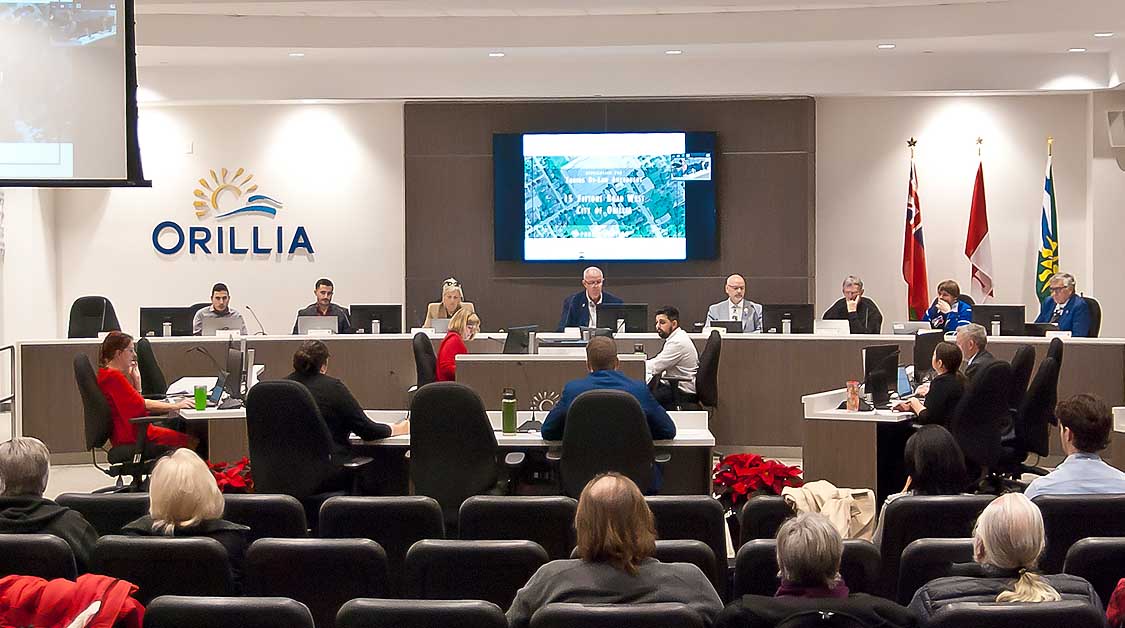
Orillia council meets at 2 p.m. Monday, February 9. The meeting begins with a deputation by Chris Peacock, executive director of The Sharing Place Food Centre and Charlotte Knegt of the Simcoe Muskoka District Health Unit outlining a proposal to turn the Seymour Conservatory in Couchiching Beach Park into a place for people to learn about growing food, rather than as it has functioned as a place to start plantings for Orillia’s municipal flower beds.
There is a plan to tear it down and rebuild a new greenhouse, but the Sharing Place has assembled a group of partners who think it would be better to convert its use and make repairs and alterations suitable for its vision because it would be less expensive than a complete rebuild.
A feature of the proposal is a classroom where people can learn about growing food, and how to prepare it. The request is to form a committee of City staff and community members to flesh out the proposal to finer detail and come back to council with a plan.
The partners are:
• Lakehead University Orillia
• Simcoe County Food Council
• Sustainable Orillia
• Orillia Community Garden Group
• Mariposa Pollinators
• Orillia Horticultural Society
• Georgian College
They believe additional partners could be:
• Local schools
• Chippewas of Rama First Nation
• Local growers, chefs, food businesses
• Other community agencies
Council will then have a closed session to consider two items: leasing public property for commercial sign purposes and a request for an amendment to Horne Business Park rights.
Poverty Reduction
When council returns to meeting in public the first report asks council to adopt in principal a poverty reduction action plan.
The working group surveyed 176 people and the top three things they said, which the City could do almost immediately, are to expand the recreation financial assistance program, reduce transit fares, and add a second human services worker to library staff to help people with housing.
The committee outlined where the feds and the province are on this issue. The federal government implemented childcare, dental care, housing, and improved benefits like the Canada Child Benefit; the working groups notes poverty in Canada fell from 14% to 6% between 2015 and 2020, but since the pandemic and with runaway price increases, has risen again (but th report does not provide a statistic). The Canadian poverty survey shows the percentage has gone up each year since the pandemic and the most recent figure from 2023 is 10%.
Ontario has a plan called the Building a Strong Foundation for Success (2020–2025), which focuses on:
1. Job creation and employment connections.
2. Linking people with services for long-term stability.
3. Improving affordability and financial resilience.
4. Accelerating action through collaboration with communities and sector partners.
One might arguably conclude there has been little evidence any of that happened. According to Statscan the Ontario poverty the latest available percentage grew from 7% in 2019 to 11% in 2023, and is rising faster than other parts of Canada.
The plan offered has 18 recommendations for action (short, mid and long-term). The three short term points are:
- Make the poverty reduction working group permanent, with a focus on implementing the plan.
- Investigate implementing a payment plan system for the City recreation programs (e.g. spreading fees over time, program duration, rather than having to pay in full up front).
- Continue to explore funding sources for a City rent supplement program
Several of the mid and long-term points are the usual look into this, look into that variety, however, finding ways to reduce fees for recreation, creating a vacant land/housing tax and free transit for social assistance recipients (with a goal to making the system free for everyone) would have direct effect.
Missing from the recommendations are job creation and doing something about runaway price increases many view as price gouging. Both are beyond municipal control, but both have to be addressed somewhere and the noisy gear is usually where change begins.
It’s tough for any municipality to take action to solve a poverty condition in a country as wealthy as Canada when the higher levels of government do little (the province), or spend money on needed access to basic services but will not do anything to address corporate greed where the problem starts (feds).
Stop, Don’t Park There
There are two items dealing with parking prohibitions and all way stops on the agenda.
One is a reconsideration of Atlantis Drive parking restrictions. Council previously created a no larking zone from 104 to 114 Atlantis Drive. This is on a curve in the road and staff said it would improve the ability to see traffic. Staff were also directed to investigate post-ban, and report back.
Staff are recommending the reconsideration in order to maintain the previous ban, but remove a ban and allow parking on the east side of the road between 103 Atlantis Drive to 9 meters south of the intersection of Atlantis Drive and Cleopatra Court.
Next, council directed staff to report on implementing all ways stops at the following Ward 3 intersections:
– Orion Boulevard and Stoneridge Boulevard
– South Street and Leonard Drive
– Isabella Drive and Stoneridge Boulevard
– Skyline Drive and Alexander Road
– Monarch Drive and Vanessa Drive
Staff have determined none of the locations meet Ontario Traffic Manual conditions for all way stops.
Official Plan
Staff want council to approve sending a letter to the assistant deputy minister of Municipal and Housing, operations division, for approval of changes in the proposed new complete application requirements of the City’s new Official Plan.
The changes are to use current names in use by the province, using charts to organize elements of the plan, and drop some studies previously required in the permit/approval process.
Housing
One might think the City is getting into the hotel business upon finding out staff want to create a Accessory Dwelling Unit Concierge Program. What is at hand is trying to meet provincial demands for new housing and keeping $4.5 million in grants for housing the City has received.
The issue is individual developers (i.e. not businesses but ordinary people who want to build) are not the experts at navigating all the approvals needed. The idea is to have a staff person help people do all the things necessary to get building permits, rather than finding out, “I need a what study too?” at the last minute.
Music Now
The Mariposa Folk Festival has an agreement with the City for the use of Tudhope Park, during the festival and storage facilities the rest of the year.
One problem, the current 10-yer agreement expires in June – just in time for this year’s festival.
Staff are recommending extending another 10-year term. There are two versions of the motion, one waives rental fees ($3,071.04), the other doesn’t.
Motions
There are two enquiry motions.
Councillor Ralph Cipolla wants staff to report on the feasibility and options to reduce the overall cost of the Downtown Orillia Streetscape project that would retain the current streetscape design elements (roadway layout and sidewalk configuration), and instead focus on:
– Repaving the existing roadway;
– Replacing streetlights;
– Reinstalling sidewalks using the same style of brick currently in place;
– Planting new trees; and
– Any other cost-saving measures that would result in a significant reduction from the estimated $18 million budget.
Councillor Jay Fallis has one to add the feasibility of making the City’s lane width standards for snow clearing mandatory lane width standards for all classes of road as part of a review of the winter control policy
Council meetings are open to the public or can be watched on the City’s Youtube channel.
(Photos by Swartz – SUNonline/Orillia)