Sustainable Orillia’s Jane’s Walk
By David Stinson – Special to SUNonline/Orillia
A dozen people joined a Sustainable Orillia walking tour of one small Orillia area on Saturday morning November 8, World Town Planning Day. This year’s theme was Great communities are built on planning — together we deliver, together we thrive, together we sustain. Held in partnership with the Ontario Professional Planners Institute, participants included local and county planners as well as members of the public.
The Nov. 8 walking tour was another in Sustainable Orillia’s series of Jane’s Walks, led by local professional community planner, David Stinson. Sustainable Orillia convenes regular walking tours in various parts of the city to expose residents to how her principles contribute to building a livable, sustainable Orillia community, and has included tours of Orillia locations such as West Ridge, the downtown and waterfront, the Narrows, and most recently the West St./Fittons Rd. intersection.
Jane’s Walk in Orillia is presented in honour of renowned urban planner Jane Jacobs (1916-2006).Jane Jacobs was an urbanist and activist whose writings championed a fresh, community-based approach to city-building. Her 1961 book, The Death and Life of Great American Cities, introduced ground-breaking ideas about how cities function, evolve and fail – ideas that are slowly being taken seriously by newer generations of architects, planners, politicians and activists.
The most recent walk began at Friends Restaurant on Laclie St. and proceeded up to Fittons Road. The walkers observed several instances of appropriate density: apartments with beautiful landscaping small rows of townhouses that don’t overwhelm. A small wooded lot there with no official status appears convenient for people to cut through (called vernacular design). While nothing is imminent for that lot, it is zoned for modest development. Stinson, who lives in the neighbourhood, hopes ground floor units will be dedicated to retail.
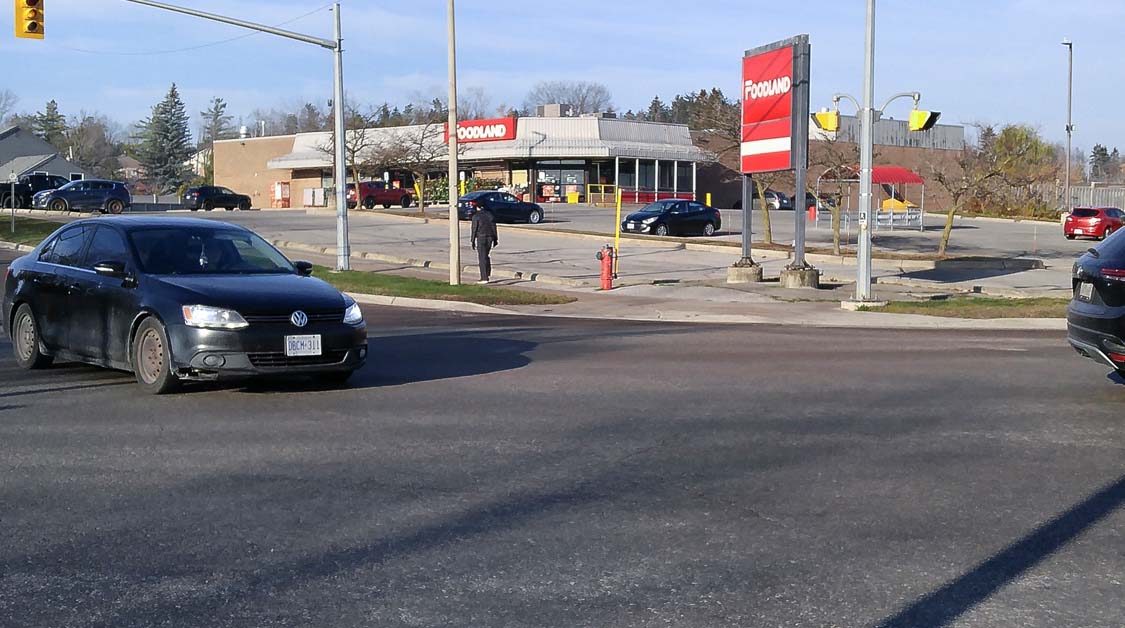
“Even now I can walk to Foodland,” Stinson said, “but there’s a big parking lot; it tells you that you get here by car. There’s a corner store but it’s not on the corner. It’s behind a parking lot, turning a cold shoulder to the street and pedestrians, suggesting that it’s not a place for people. It’s missing a sense of place, not comfortable or welcoming. Cars zoom by.”
Then walking south to North St., they observed new pavement on Laclie Street, a section of road referenced several times during the municipal all-candidates meeting. Walkers contrasted the width of the old pavement with the width of the new lanes. Stinson noted how road width affects traffic and its speed; the wider the pavement, the faster the traffic. While the new pavement has a good cycling lane, the new traffic lanes are wider, consequently increasing speed.. People drive according to what they consider a comfortable speed for the environment and conditions, and when a 10-foot wide traffic lane expands to 12 feet, traffic speed has been shown to increase.
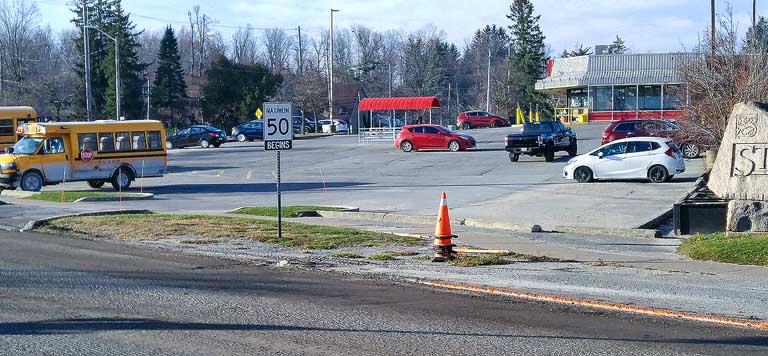
Walking down Laclie, participants looked at the businesses fronted by parking lots. If instead, there were parking on the street, traffic would slow down. Referring to the work of traffic expert Donald Shoup who says on-street parking is also better for businesses because it makes people get out of their cars and walk past other businesses. One report suggests that one on-street parking spot is worth $10,000 to any business along that street.
According to experts, an attractive, walkable streetscape creates a wider awareness among other residents in the neighborhood that they can walk there. Author Jeff Speck’s Theory of Walkability is that a walkable neighbourhood has four component parts: it’s useful, comfortable, safe and interesting. Participants on Saturday’s walk noted that the Laclie St. stretch is indeed useful and the new sidewalk is comfortable and safe.
Why do David Stinson and Sustainable Orillia conduct Jane’s Walks?
“The point of my chosen profession,” Stinson said, “is creating sustainable, livable communities. I try to emulate the great teachers I’ve learned from. Our town could be healthier, wealthier, and wiser better if we built in more of these design principles. I like to get people to think about them. So many people just zoom through their communities without giving them a second thought.
What did people take away from Orillia’s November 8 Jane’s Walk? “I hope they took away a feeling for the importance of a sense of place, and how they discover that through walking,” Stinson said. “A car should be an optional instrument of freedom, but for most of us, it’s a required prosthetic device.”
Go to walkscore.com and key in City of Orillia to see how walkable this city is.
(Images Supplied) Main: An example of the juxtaposition of pedestrian and vehicle traffic.