Council Preview
By John Swartz
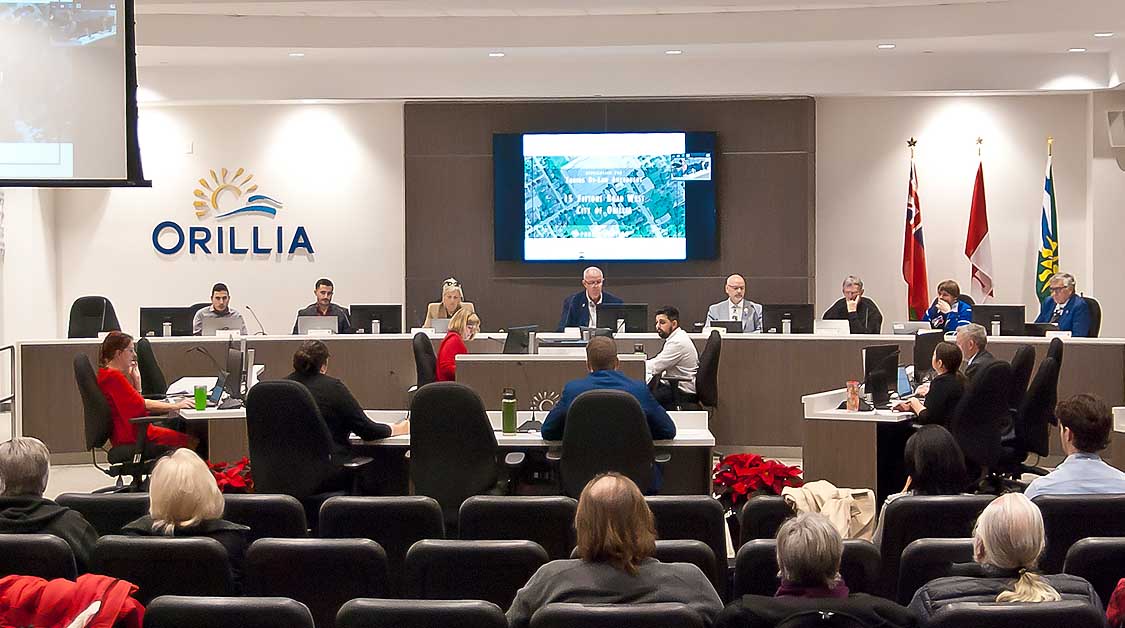
Orillia council has its first meeting of 2026 Monday, January 12 at 2 p.m. There are no deputations or presentations, so after opening meeting formalities council will move directly to the public forum, and then to a closed session.
The closed session has one item, to hear about a solid waste collection contract extension and settlement (presumably final accounting of the existing contract).
When council returns to the public, they have only three reports on the agenda. The first is from councillor Tim Lauer who wants to have a question on the ballot for the next municipal election:
“Are you in favour of returning to an at-large Municipal electoral system that would allow all eligible Orillia residents to vote for all nine members of Municipal Council? Yes / No.”
Orillia changed to a ward system to elect councillors in 1999 (for the 2000 election), “without a plebiscite and without the issue being properly vetted through the electoral process.”
This question was raised in November 2024 and council rejected the idea. Lauer states Orillia Matters ran a poll. Despite online polls being notoriously unscientific and easy to game, the result was 212 yes and 58 no, with 276 taking the poll (which one might notice the math does not add up).
Lauer also states the new strong mayor powers put more distance between voters and council and allows minority rule over decisions.
Staff have an accompanying report outlining legal framing to have a plebiscite and the timing involved should council want to have the question on the ballot. They cannot pass a motion after March 1, and there must be a public meeting. Staff are suggesting a public meeting for January 26 should the motion from this report pass.
One of the requirements post-election is council must act on results and there must be greater than 50% approval by greater than 50% of eligible voters. One problem is only 32% of eligible voters went to the polls in 2022.
Even if council votes in favour now, and it passes the hoops for a by-law vote in early February, the real challenge will be getting 18% more voters out to the polls. Even if a question gets on the ballot, anything less than 50% turnout changes nothing.
Many voters over the years have expressed dissatisfaction with one council decision or another with the sentiment ‘it’s those councillors I didn’t get to vote for that are the problem’.
While that may be true, the counter argument is voting for all 8 seats will likely result in a weaker field of chosen councillors. It takes time and money to run for council. Typically candidates want to knock on every door in their ward and speak to as many people as possible. Not everyone is available to answer a knock, but the effort to be present at each voter’s home is important. It will be impossible for any candidate running for a council seat to reach every door in the City, guaranteed.
Name recognition will count for much more than good ideas. Most people running for council do not have a campaign team, that means a candidate is doing all the work by themselves, or with the help of a few friends, which is not the case for people running for mayor who have dozens of people working on their campaigns and much more donations to fund those campaigns. A council populated by the best candidates is not going to happen.
Many people with good motivation and qualities who might run will assess the task of campaigning city-wide and choose not to run because the task is too great and too costly.
Also, in the 1997 election 7 out of 8 councillors were from the north end of the City. This was the major argument for changing to the ward system – that the rest of the City was not represented on council. It should also be noted most of the ’97 councillors were retired people or self employed, they had time to run.
In 1997, the last at-large election, there were almost 28,000 people living in Orillia. There are now more than 33,000. The projection is there will be 41,000 in 5 short years. That is more doors to knock on with either system, and there will be more doors added with each subsequent election. The task of running for office is not logistically getting easier, but harder.
Another thing which happened when elections were city-wide is the hot item of the moment dominated races. While not necessarily bad, it did tend to push out other concerns from being considered during elections. People with ideas worth considering got pushed out by the gravity of the hot issue. While not consistent, each ward at various elections often had more candidates running than the total number of council seats
It seems natural voting for each member of council is better, but the reality is the candidate field will be limited and less qualified; the variety of experience will be less, and worthwhile ideas will get lost in the shuffle. So far, elected councillors have acted on issues of concern to all and there has not been a dominating force to act only in the interests of the wards councillors come from. This is often observed in larger cities, and each elected councillor will have to work hard to not let that happen. On the other hand, ward councillors have quite often brought issues specific to their wards, often issues no one advocated for when council was elected at-large which have affect on everyone.
On the other hand a wager could be made had council been elected at –large all this time, with representation mainly from the north end, Laclie Street would have been fixed long ago.
Park It Over There
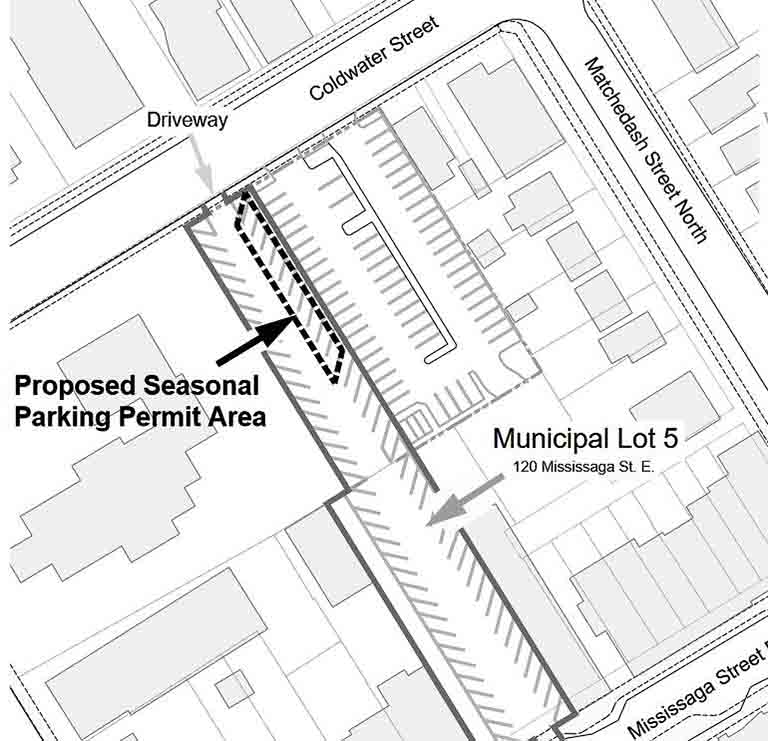
Staff have a report recommending council approve ten new overnight parking spots in lot 5 (opposite Mr. Seto) in addition to the 15 spots in lot 6 (Andrew Street far end of the block from City Hall) and 10 spots in Lot 1 (Colborne Street). This applies only to the period winter snow plowing and parking restrictions are effective.
The charge would be $375 annually (prorated to $225 for this season only; the lots 1 and 6 charge is $1,250. There are still 6 spots available between the two existing lots. Permits would be available for lot 5 January 15 if council passes in committee and ratifies right away. All permits for all lots would then be available each year starting the first Monday of October.
But Don’t Park There, And Get Out Your Snowshoes
The 2026 Ontario Winter Games committee has a report asking council to close an area east of Front Street and Laclie Streets and between Borland and Elgin Streets and close all waterfront parking lots for the opening ceremonies, which will occur in two instalments February 19 and 26 at the waterfront parks.
At the last games in 2018 what is now Lightfoot Drive was closed from Mississaga to Brant Street only. With this request, it is a lot of parking usually available for other events of similar and larger size at the waterfront taken out of play. The report states they expect only 2,500 people to attend each ceremony. Canada Day has many more people attend and there are no street or parking lot closings.
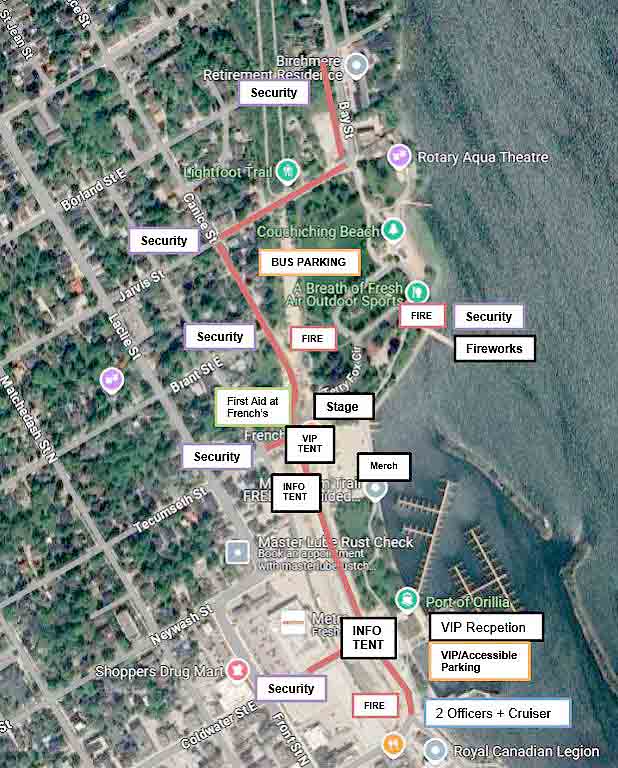
This will also mean rerouting Orillia Transit service, but staff recommend special event transit stops somewhere near the contained area will be set up to encourage people to use the bus to get to the event (which also features fireworks).
Two things, Orillia Transit does not have the capacity, and it could very well be cold and snowy and asking people to park so far away for this event when other events do not have the same conditions imposed is asking a little much.
The streets proposed to be closed are:
- Bay Street from Borland Street East to Jarvis Street
- Jarvis Street from Bay Street to Canice Street
- Canice Street from Jarvis Street to the Terry Fox Circle
- Lightfoot Drive from Tecumseth Street to Mississaga Street East
- Coldwater Street East from Front Street North to Lightfoot Drive
- Access to Canice Street from Brant Street East
- Tecumseth Street from Parkview Avenue to Canice Street
Motions and By-Laws
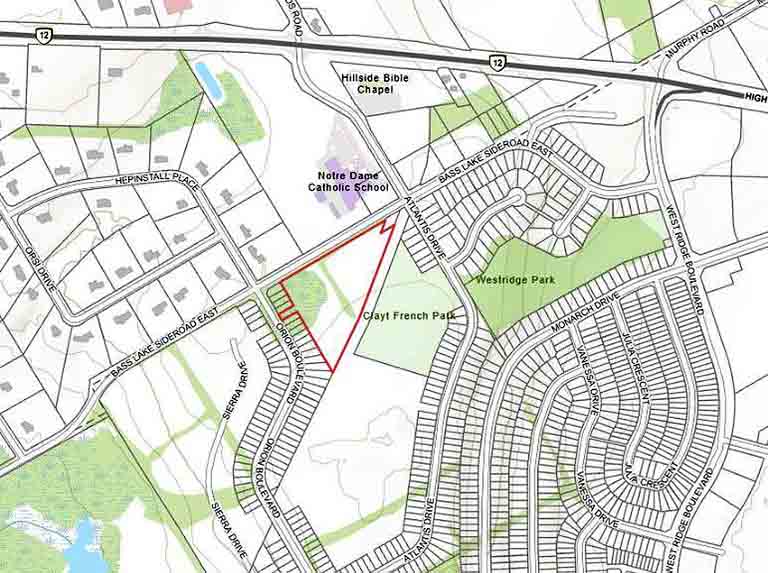
There are no motions on the agenda. Of the by-laws listed two are worthy of attention. One is to remove a zoning holding restriction for property on Bass Lake Side Road opposite Notre Dame Catholic School owned by the Simcoe County District School Board on which a new school is proposed to be built.
Another is approve the sale of 360-372 West Street South (formerly Orillia Power/Hydro One and currently used as a warming place) to Craig Morin. It should be noted there is no price stated, and other than the old train station prices have not been stated for land purchases or sales from some time (not even for 70 Front Street North). It seems it would be in the public interest to know those details.
Council meetings are open to the public or can be watched on the City’s Youtube channel.
(Photos by Swartz – SUNonline/Orillia)