Council Preview
By John Swartz
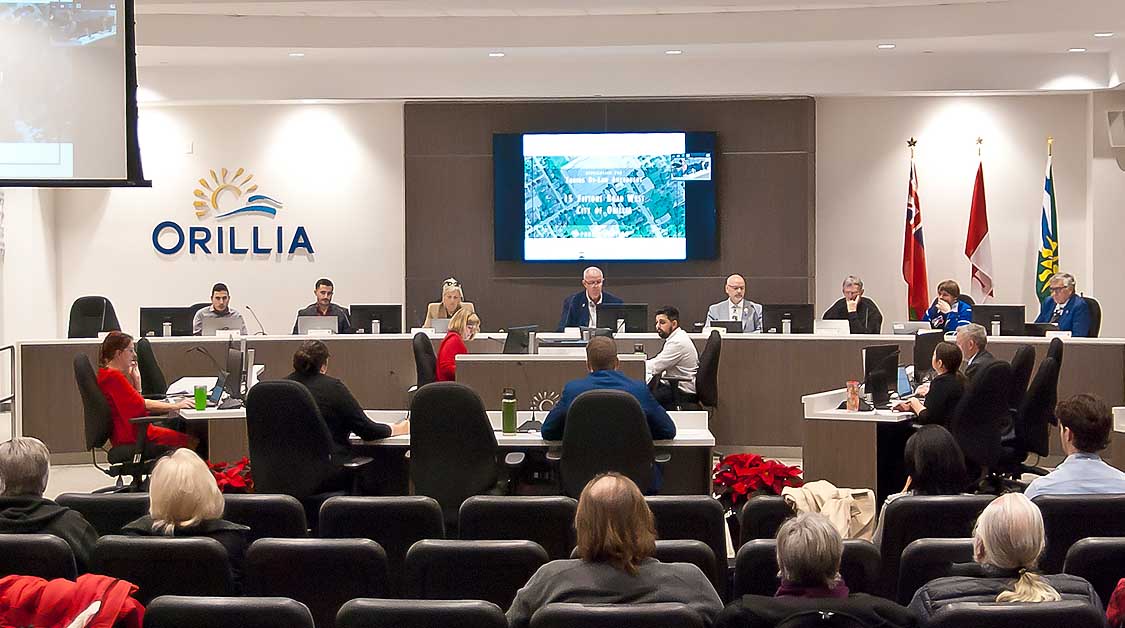
Orillia council starts its Monday December 8 meeting early at 10 a.m. for the next phase of the 2026 budget relating to the service agency portion. The agenda for the special budget meeting has no documentation and states, “Verbal Update on the Mayor’s Proposed 2026 Operating Budget – Service Partners.”
When the budget meeting is finished it will be time for the annual awarding of trophies for participation in the chamber of commerce’s Santa Claus Parade. The public forum follows and then council will go into a closed session.
Bear in mind, council meetings are not supposed to start until 2 p.m. There is no indication whether things will just motor ahead before 2 p.m. once the budget meeting is done. On the other hand it must be the case the verbal update will take at least two hours and with an hour for lunch, the regular meeting will start at 2 p.m.
The closed session has four items listed. One is regarding negotiations with the Orillia Power Generation Corporation for a request to amend the equity financing agreement with the City.
Two items are for disposition of land in the Horne Business Park, specifically lots 12 through 16. Another is for staff to get direction from council to close the Andrew Street South road extension; technically Andrew Street continues on from Barrie Road through to Queen Street, but has never been completely developed as a road. A report in the public agenda states there are no abutting properties that need the existing developed part of the road, and by closing it the City will save maintenance costs. Making this change will cost $12K in document preparation and legal costs.
Reports
When council returns to face the public, they have 16 reports to deal with.
Mayor Don McIsaac has a report which asks staff to develop a Voluntary Contribution Program. The report says:
“… is a municipal tool that allows residents, businesses, and community groups to make optional financial contributions that are completely separate from their required property taxes. These programs are intended to supplement, not replace, traditional municipal funding…”
Why might the idea of creating this policy be coming up now? Given the recent budget discussion regarding the Orillia Public Library and a donation it expects to receive soon, a substantial donation, and the qualification on the budget motion that the increased operating budget council voted for be recovered from that donation, it seems pretty clear why.
Council already controls any donations people make to the City, the monument and statue for Gordon Lightfoot, the half million the Rotary Club gave for the Rotary Place arena, the memorial to the Farimile explosion all had to be approved by council, and in some cases of the donations expenses incurred to accommodate the donation.
The Orillia Youth Centre also runs successful fundraising campaigns and events to supplement their operating budget in order to buy supplies for the programs they run.
The City can’t touch cash donations to the Library. Beside the OPP, the library is the only public service the City pays for council does not control. SUNonline/Orillia wrote an editorial explain everything and you can find it here. In short council does not control the library’s reserve funds, which exist only because of donations to the library. This council, and all the council’s before them have wanted to.
The library has substantial reserve holdings. So this part of the report can only apply to one case:
“The risk of uneven support for certain services can be addressed by ensuring designation options reflect Council’s priorities and by maintaining equitable baseline funding for core municipal services through the City’s operating budget.”
The Opera House has some reserves, but an accounting of the status and use of those reserves has not been made public in years and certainly not at budget time when both the Library and Opera House reserve statuses were part of the budget submissions. Memory of the size of the Opera House reserves is ancient, but at the time of the last perusal it was not as great as the library’s.
It is interesting to note apportion of the ‘sample’ policy being offered includes:
“Conflict of Interest: Strict prohibition on linking donations to approvals or services,’
And would have been a problem for the four donations mentioned above in that council had to agree on the locations, and do work at City expense for them to exist. It is also the case with the library.
To be fair, the sample does also include: “…will not affect taxes or service levels.” And, “Equity Considerations: Ensure core services remain funded through municipal budgets, not donations,” which is exactly opposite of what happened with the library budget approval.
The next report is also from the mayor and councillor Tim Lauer. They want to waive policy to cover fees the Simcoe County Elementary Athletic Council would pay to hold a wrestling tournament at Rotary Place in May.
Council has been making this concession since 2016 and amounts to waiving the fees charged to any other group. The policy prohibits making grants to various publicly funded organizations, including school boards. The grant would come from the grant committee budget, which is increasingly being used to make grants to groups and activities well beyond the arts and culture use the grant budget was originally set up for. The exercise just means money does not leave the City’s hands by granting the cost of facility rentals to the tournament which is then deposited to the parks and rec account where fees go.
The next item is from councillor Ralph Cipolla, who chairs the Couchiching OPP Detachment Board, who has a request from the board to have the City supply administrative support to the board for the 2026 calendar year.
This could be an assignment of existing City staff, or a new hire. The OPP has been having trouble filling this part-time position. The surrounding municipalities also participate in the functioning of the board.
Gather ‘Round Kids
Councillors Cipolla and Whitney Smith have a report asking staff be directed to report on what municipal lands might be suitable for a childcare facility.
The report states there is some support on council for a municipally operated facility. The report mentions the facility could be privately operated. Not included in the motion, but the conclusion of the report states:
“The report will provide Council with a clear understanding of the feasibility, benefits, and costs associated with establishing a city or private-operated childcare centre and whether any city owned property is suitable for this purpose.”
Poverty Reduction
The next report is one with a better functioning provincial government and better attention by the feds would not be necessary. A lengthy report outlines how the city can deal with poverty in our community.
The report states statistically Orillia has 12% of the population living in poverty conditions, and that household income is the lowest of 13 in Simcoe and Dufferin Counties and Muskoka. We also have the highest percentage (39%) of people renting in Simcoe County.
The committee conducted a survey and found 70% of the respondents (176) were of working age and more than half of those had full-time jobs. So ‘get a job’ will not solve the problem. Jobs with decent wages, which generally happen when the minimum wage is set to something resembling a living wage happens would go a long way to reducing poverty. Of course having a supply of jobs also helps.
The City already has a poverty reduction working group, which their work so far resulted in hiring someone to be the committee’s administrative support at a cost of $47K. They produced a plan which has 18 points for action and this report prioritizes those points.
The top three priorities are to make the committee permanent, to create a payment system for municipal recreation programs (stated elsewhere in the report for the purpose of subsidizing fees), and to continue work to implement a rent subsidy program. Those could be read as easiest to do right away.
The balance of the recommendations involve using resources from existing departments and working groups (including non-municipal) in a coordinating way.
The last, an ongoing action involves advocating with the province and feds for policies and action. This maybe the most important one. The province controls the expense of the pitifully low welfare and disability programs and sets the minimum wage, they control healthcare and education expenditures, which have been falling behind – in short the province is absent in this discussion. The feds have ability to aid and promote investment in job producing activities and to investigate and control rising prices for necessities like food and housing.
One could conclude both have a ‘nothing to see here’ position in the debate. They seem content to let municipal property tax payers shoulder the burden when municipalities have fewer resources and did not create the problem.
Changes To Dealing With City Hall
A staff committee report outlines some changes to how the parts of City functions you deal with is next. Two big ones are, changing the hours of operation at City Hall to 8 a.m. to 5 p.m. starting January 1, 2026, and changing the limit The City will allow for credit card payments and applying a convenience fee to credit card payments in the amount of 2.4% (they already do add this fee for payments up to $2K). A the same time they are adding a long list of fees for which the City will accept credit card payments
Funny thing about those convenience fees to pay for things with plastic, which has become the norm (the province won’t even accept cash for some transactions), credit card companies charge both card holders and accepting companies and organizations a fee for use. Business have been pawning off their fee to customers for years now, and the City has done so too, when rightly their fee should come out of the price charged, but is instead being tacked on. Do you have a good grip on your end of the stick?
They are also updating policy regarding how staff handles questions from the public and dispute resolutions. Specifically how incoming correspondence and communication is directed, handled and responded to (how and when). It’s interesting to note, to date, there has been no official response of any kind to a letter SUNonline/Orillia sent June 18 to mayor and council (sent to each member) regarding reviewing performances at the Opera House.
Show Me The Money
A report from the grants committee recommends approval of grants for the 2025 budget in this manner:
- Canadian Federation of University Women Orillia $1,500
- Hospice Orillia $1,500
- Royal Canadian Legion Branch 34 $1,200
- Cellar Singers $1,500
- Independent Living Services $1,500
And an amount of $2,371 special event grant to the Terry Fox Run. At the same time the committee is recommending $2,500 grants to Arts For Peace and the Festival of First Nations annual event (Arts Orillia) from the 2026 budget.
There is $25K left in the budget of $50K from 2025 prior to awarding the above grants.
How’d That Go?
A report from development services and engineering provides council with the results of a pilot project of proactive, rather than complaint driven, enforcement of the clean and clear by-law.
Staff reports 17 properties were inspected beginning in May 2024 and as of November this year 25 properties are being inspected. On 6 occasions contractors were hired to remove items or cut yards. 60$ of properties inspected were rental properties.
Staff want council to make the program permanent.
Drive Safe
Following up on a defeated motion last September to install four way stops or a traffic circle at Orion Boulevard and Monarch Drive, council asked staff to report back on costs and to do a study in the fall of 2026..
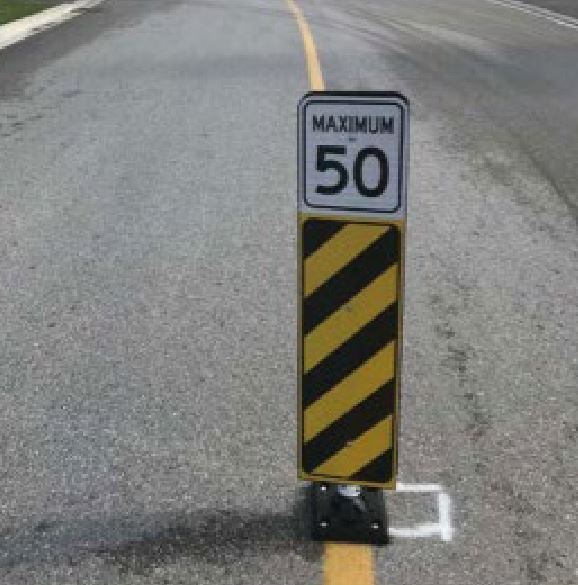
Staff are still not recommending knockdown posts be installed (these are of the type installed on roadway center lines, possibly with speed limit indicators) this spring, and staff should not do another study of conditions in the fall of 2026. The new information is it would cost $36k to install the posts and to also install speed bumps.
Another report from staff about a council direction to report on the speed camera results so far and red light cameras has turned into a report on red light cameras only. It appears red light cameras have run into a problem – and it’s not the car in front; they will not be the cash cow some expected.
It’s important to note the report states:
“Vehicles that enter the intersection on a yellow light, or those that were already in the intersection before the light turned red, are not penalized. Only cars that pass the stop line after the light has turned red are photographed”
Unlike with the speed cameras there is no infrastructure to install, maintain, or manage fines, and only the City of Toronto has a program in place. The City would be on its own to manage the cameras.
Staff estimate it would cost $250K – just for the software (which works with Toronto’s) to start a program. Toronto’s only involvement after that would be processing images. That’s for setting up the program. Ongoing costs would be up to $75K for Toronto’s part in the scheme; 36K annually to operate each of 10 cameras, $125K for a program manager; $85K for someone to screen the images, additional staff $80K.
The total startup costs, including installing cameras, the software and payment processing would be $480K
This is balanced by a staff revenue estimate of $260K, In other words the City would lose $500K annually. Staff are recommending to receive the report, which means do nothing.
Housing
Two housing projects are in line for grants under the federal Per Door Grant program. They are for twelve rent geared to income units Hillcrest Lodge wants to build and for the downtown 115 unit affordable housing project which will take up the parking lot on Coldwater Street opposite the Central School (known as 26 West Street North).
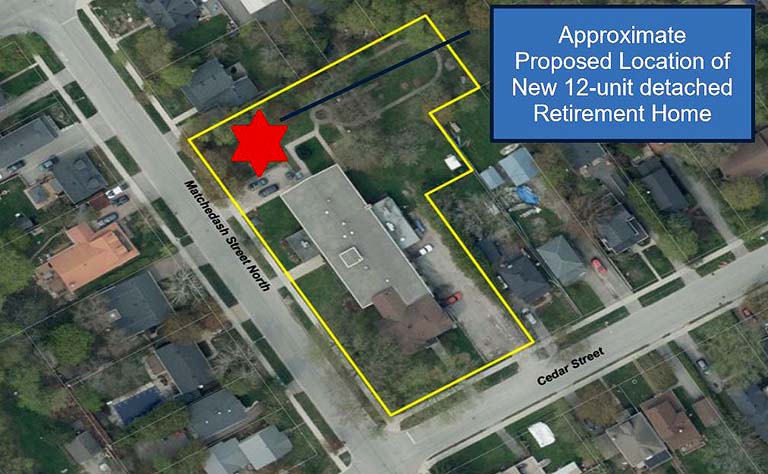
Hillcrest expansion site 
Hillcrest artist’s rendering
The City approves the grants,, the feds pay. Hillcrest will get $86K and the developer of the other project, Sionito Communithy Development, will get $1 million.
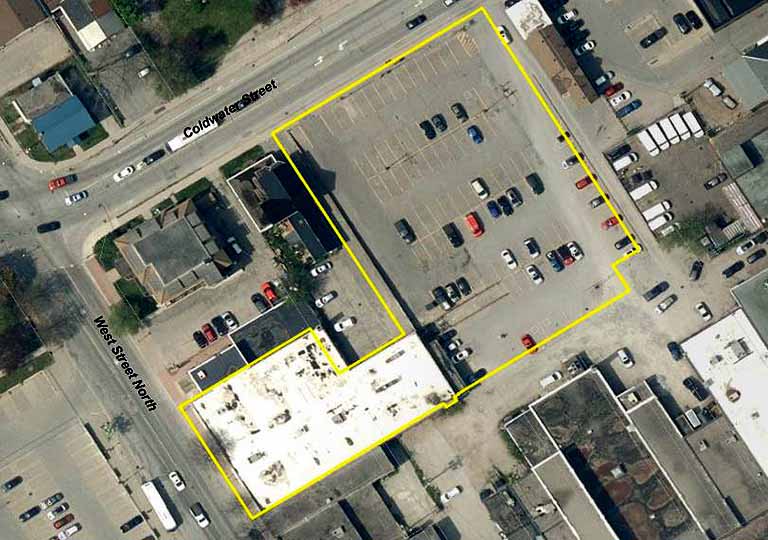
The City is eligible for $4.5 million in funding over the next 4 years.
How High Is The Water?
The City’s ongoing storm water management master plan update needs more money. The consultant, Aquafor Beech Limited, has higher costs and needs $15K added to the $150K budget. Some of the data needed does not exist and alternative methods have been used to fill in the picture (which has caused the project to take longer to complete than the 2022 due date). Consulting fees have also increased.
Staff are saying the missing data falls on the City for responsibility and the extra work, which pushed the deadline beyond the original project cost is reasonable to pay for
Uh-Oh
The city built two biosolid lagoons at the waste water treatment plant in 2014. They were lined with a rubber film. It turns out rubber can tear. The liner in the south lagoon could not be repaired sufficiently and is being replaced with what staff say is a heavy duty plastic liner more resistant to tears.
The problem is the cost is going to be $377K instead of the $226K asked for in 2025, so staff want council to increase the budget by $151K.
Control Yourself
The City’s acceptable behaviour policy is not keeping up with the general degradation of civility in society and staff are also finding they are dealing with increasing incidents related to mental health and addictions.
They have a new policy for council to approve for all municipal facilities which borrows from their Respect+ program already in use at recreation facilities. At the same time staff are asking council to impose a $500 appeals fee, which would be refundable if resulting action on the City’s part is reversed.
Youth Centre
There have been rumours the Youth Centre may be relocating, and many have wondered why the City bought the former train station on Front Street. Now we know, yes, the youth center is moving, and it’s to the train station.
Council has a report to authorize renovations and to start a fundraising campaign. Hopefully they won’t be eyeing money already raised for programming. This is the issue with the library reserves, people giving money for one purpose and then council using it for another.
The train station is about 200 sq. ft. smaller than the current location. Layout makes a difference, the current one is essentially one large room with washrooms and an office carved out of the space, plus some storage in a less than full basement. The train station is a series of rooms which may not be optimal for running programs.
At least there is an opportunity to use space on the property besides the building for storage. Plus, it has parking, which the current location does not have any kind of abundance of.
The City budgeted $1.5 million in the 2026 budget for relocating the center. The City sold the property in 2019; it was listed at $900K but the sale price was not disclosed. The City bought it back this year, but the price again was not disclosed. A cost estimate or scope of renovations is not included in this report.
Motions
A postponed motion from the September 22 meeting is back to install four way stops at these intersections:
– Orion Boulevard and Stoneridge Boulevard
– South Street and Leonard Drive
– Isabella Drive and Stoneridge Boulevard
– Skyline Drive and Alexander Road
– Monarch Drive and Vanessa Drive
There is also a postponed motion form the November 17 meeting to endorse a chamber of commerce effort to have the province widen Highway 12.
The mayor has a motion asking council to restore free parking downtown during the Christmas season. In order to do so, the 2025 budget needs to be changed, so a reconsideration motion is offered. This will change the contribution to reserves from $199K (lost parking meter revenue) to $169K (which might be indicative the free parking period is not as long as it has been in previous years).
The mayor also has an enquiry motion for staff to report which parking lots have the capacity for overnight winter parking. Councillor Fallis has one for staff to report on options and feasibility to, “provide the removal of snow from the full travel width (curb to curb) on Class 3, 4, and 5 highways.” Councillor Lauer has one (following up from budget discussions regarding reserve contributions) for staff to report on, “strategies to accelerate the current asphalt resurfacing and sidewalk replacement programs.”
Council meetings are open to the public or can be watched on the City’s Youtube channel.
(Photos by Swartz – SUNonline/Orillia)