MacBeth On Stage
By John Swartz
Mariposa Arts Theatre opened their fall production, Macbeth, last week. It is maybe one of the best known plays attributed to William Shakespeare. OK, maybe the best known title of one of Shakespeare’s plays. I say attributed because there is some in academia who believe the play we know today was not exactly the play Shakespeare wrote, but rather reconstructed by others from what he wrote as guided by a prompt book for the play.
A prompt book contains all the information, staging, lighting, cues and script. Adding to that, over time various companies made changes, some that took, which have survived and may have changed the intention of a scene or line.
That said what we have is a story we recognize as coming from Shakespeare. Producing, directing and acting out the story is not easy. The lines are so old that a literal translation today of words and phrases in vogue in Shakespeare’s time may miss by a little or a lot.
So, lots of room for error.
There is one major problem with the play I saw on opening night, which complicates my assessment of how it went. That is the quality of the audio. So, I will not be going over specific actors contributions.
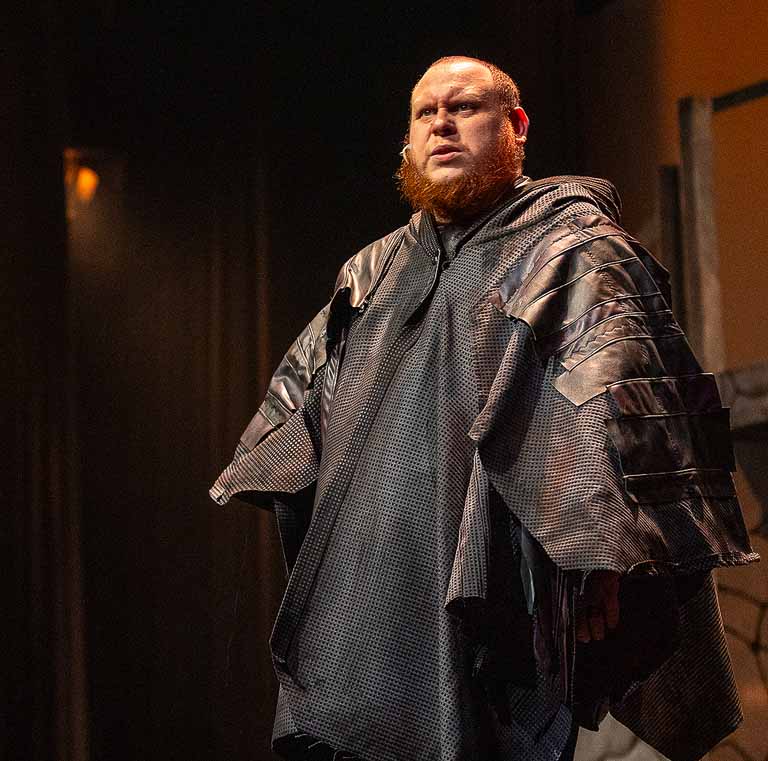
Other than to say, the lead actor, Colton Farro, should be proud of how his character came off. Since I could not tell a thing from the lines he said, I paid attention to his physical actions. This is his first turn as a lead actor. He has been in other MAT productions in secondary roles.
There is no mistaking the story revolves around him because of his physical command on the stage and his interaction with the other actors. With no knowledge of the play and no sound, anyone could tell the story was about his character. Taking away one of the main tools he has, the words, he still gave us a fantastic performance.
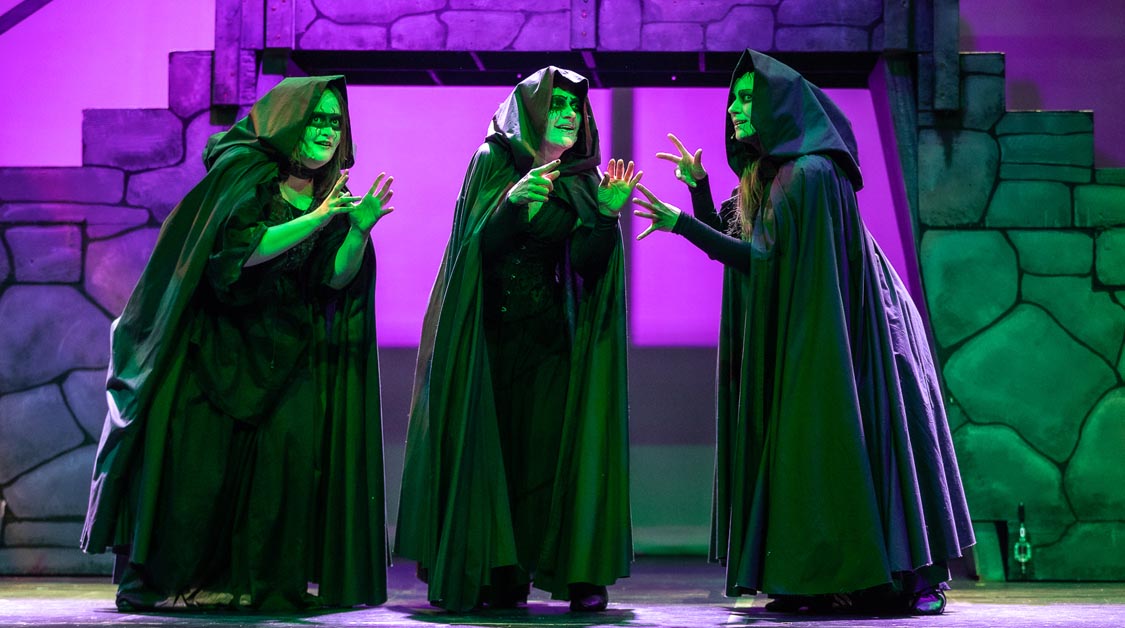
The witches were entertaining, green skin and all. Fortunately we know enough of their purpose on stage that the words lost did not take away from their choreography and portrayal.
I also want to mention Patrick Voo’s exit when his character transitioned to a ghost. His scampering on all fours, backwards, will live in memory for a longtime. It was well executed, and frankly very funny.
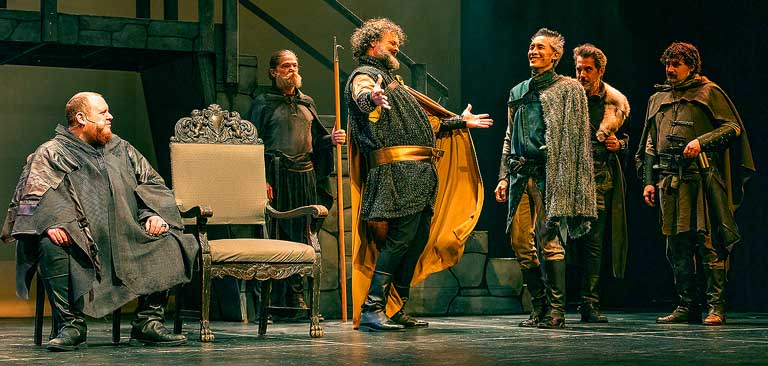
The set is the most minimal MAT has put together in many years. Brian Halbot has designed and built such fantastic sets in the past we may have been conditioned to expect something quite elaborate instead of the fairly simple flats on rollers treated to look like stone walls, and a bridge like one might find in a back yard over a stream.
The costuming was also excellent. While some productions have taken liberties with dressing the actors, here there is no mistaking the time period of this story. And the mix – some actors did wear simple costumes, and others had quite a bit of detail work to them.
It is also worth mentioning the music. There was a lot of it between sets and scenes, which had the distinct quality of a video game score and really set the mood for what was to come next.
These things still make for a spectacular production.
Now for the difficult part, it is hard to sit through a production and not be able to understand one word of what is being said. This is an issue that has plagued all kinds of productions in the Opera House, particularly the ones that do not have a lot of singing involved.
All the actors wore microphones. This has become almost mandatory for companies that are composed mainly of people who have no stage training, particularly voice projection. That said everyone on a stage, in any setting should use a voice volume sufficient to reach someone sitting in the last row and let the person running the board deal with balancing levels; it is far easier to bring a level down for someone who is louder than everyone else than it is to amplify a voice that is weak.
It was as if every actor had a hand over their mouth to muffle the words. I have been told it’s my ears when I get irritated by poor sound quality, but here’s the thing, when I suspect something is off I ask others what their experience is and every time I get, ‘I thought that too.’
I also get told, ‘it’s where you are sitting,’ which is a bad excuse since I try to get seats in the same general vicinity of the main floor for every show. This time I was not in that place, but I was two rows in front of the sound mixing board, and the operator. It is also the same place I had for the Lightfoot Band a week prior, with a program that included a lot of story time (i.e. talking) and the sound there was completely different.
I did that this time. I asked if it sounded like everyone sounded muffled to the point of making the words hard to distinguish. I was not alone.
No human voice sounds like that, but far too often when run through a PA system there is a ton, way too much, boominess. Just make people sound like people.
For this to happen to work by Shakespeare is a tragedy in itself, never mind the play is a story of tragedy.
I have mentioned the fix many times before and maybe this time the message will get through, and it is a message I should not have to give.
Take out the mid frequencies.
That’s it, real simple. There are two ways to this. On each rail (mic input) dial back the mids to about nine or ten o’clock, maybe more for some voices, and then boost by a lesser degree the highs a little; this boosts sibilance, the parts of speech that distinguish or break up the sounds of speech, thereby making words.
The other method is to use a graphic equalizer at the end of the chain and take out the frequencies at 300 and 600 hertz. Not bring them down, take them out of the mix entirely. Tweak everything from 2k to 4k down about 3 to 6 db and leave everything else alone at the flat position.
This is what most people do who run sound in major venues for major acts and they get paid not to deliver bad sound.
Just because the meters say things are OK, it’s always a good idea to use one’s ears and ignore the meters if your ears tell you it doesn’t sound good.
I guarantee doing those things will make it sound like the actors are right in front of each member of the audience instead of on the stage. Try it and see.
That works for almost all settings and is good to know if you occasionally have to rig up a sound system for a different affair, a dinner with a speaker, a press conference (I’m looking at you who run City of Orillia functions). Mid ranges are the enemy and they need to be corralled.
One of the things MAT has done in recent years is have their fall productions in Gord’s Room, which has allowed them have more than double the audience size they would have had in the Shilling Theatre.
There are performances of Macbeth at 7:30 p.m. Thursday through Saturday and a 2 p.m. matinee Sunday. You can get tickets online.
(Images Supplied) Main: The witches of Macbeth, now playing at the Opera House (all photos by Deb Halbot)