
Council Preview
By John Swartz
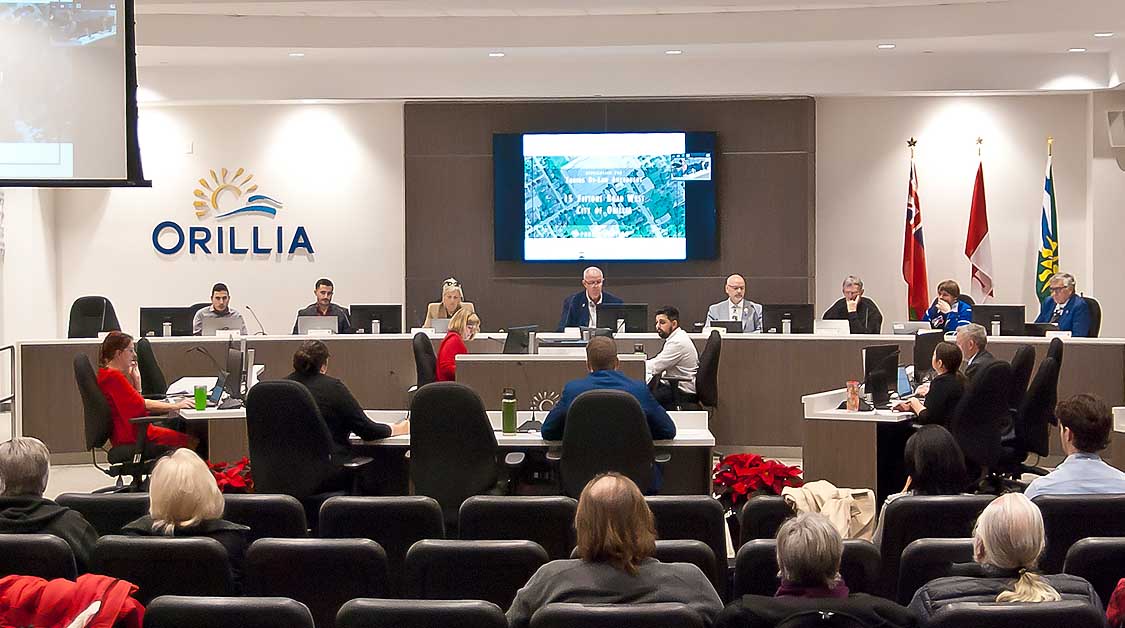
Orillia council concludes its term of office Monday, November 9 with its last official meeting at 2 p.m. There are two controversial items on the agenda, but first council will breeze through the opening formalities, and with no deputations or presentations go into closed session following the public forum.
In closed session there are three items. One is to discuss a land acquisition. The second is to get an update on the Orillia Recreation Centre’s cooling system. The last is regarding an appeal to the Ontario Land Tribunal for a property at 16 First Street.
One thing the incoming council could do is demand more information about closed session items be made public as it used to do. For example, with the first item, what land? For what purpose? On the second, why is that one even a closed session item? And Third a Cole’s Notes version of what the issue is would be helpful in knowing what The City is facing.
It’s not about keeping things confidential that affect the public purse, which is the underlying reason for having closed sessions on some items, but to let citizen’s know the basic details so we can judge if the proper outcome was achieved.
Even when the public motions are revealed there is still no indication of what was at hand and far too often any by-laws resulting are equally devoid of basic information. This is not healthy for taxpayers. It didn’t used to be this way and it shouldn’t be now. This is purely a way of hiding information from the public which the public has a right to know. If a municipality is contemplating spending money of buying property, taxpayers have a right to know which property and why it’s the target for acquisition. If it’s an appeal, in this case is it for an Official Plan or zoning by-law change? Is it to oppose a ruling on the size of a deck, an appeal about the base use of the land and/or buildings on it, and for that matter which party is appealing, the property owner of the City?
And if something is wrong with the cooling system at the rec center, what is the problem? How bad is it and what is the proposed solution? Why is that information unsuitable for the public to know?
This is something that comes up with every council meeting with a closed session. Too little information and shielding from the public about what our business is and it needs to change back to providing some basic information.
Parking
Mayor Don McIsaac has a report asking council to grant two parking spaces in Lot #2 (off Colborne behind Mariposa Market) to Mariposa House Hospice for volunteers to use during their Angel Tree Campaign at Mariposa Market from November 18 to December 23.
What is notable about the report is staff have attached an amount of $682 in lost revenue to the request. This is common for requests from civic groups looking for a little relief on costs to stage their events, attaching an amount of lost revenue.
I don’t know about you, but it is a rare occasion, very rare, this writer cannot find a parking spot in the general vicinity of the destination. How is it staff is so sure those two parking space will be occupied 100% of the time? What if someone who might have used a particular parking space had to instead park in another one that is open? Is that lost revenue? The City is not always going to lose a buck or two every time they allow people trying to do some good in the community to park for free because most of the time people will just pull into a space two or three down.
A different parking issue is the subject of another report. Staff were asked by way of an enquery motion to report of extending free parking for those with disability permits to park in any parking space free of charge.
The City has 31 handicap parking spaces and does not charge for parking in those spaces. This move would only extend those privileges to those who are forced to park in a different space.
Staff do not recommend doing this. They say by way of some extreme math that the City would lose 7% of its parking revenue, $50K. They also say because the City already has more handicap spaces than regulations require it’s not important to do more. They also say letting the handicap park wherever does not solve other barrier problems, so the City should do nothing.
The tone of the report is, we already do something, so why should we do more. People with handicaps already face a more expensive existence, is it more noble to extend a hand or pick their pockets?
Oh No You Can’t
Councilor Whitney Smith has a report asking council to endorse an appeal to the province to tighten eligibility requirements for those seeking municipal office. Primarily she wants rules tightened to disallow candidacies of people convicted of serious criminal offences.
She also wants the province to look into if it is worthwhile for candidates to get a Vulnerable Sector Check, or another appropriate level of police record screening.
Furthermore, the motion includes: “provincial framework establishes clear and consistent standards respecting the types of convictions that would affect eligibility, applicable periods of ineligibility, record suspensions and other relevant legal considerations.
This is so broad, in itself it could be considered an abuse. For example if some has received a pardon for a conviction, that pardon would then become meaningless if one stands for election. Also, anyone who received conditional discharge (which usually means if that person fulfills the obligations of the discharge then no conviction is given) would be caught up in this.
On the face of it, this seems to a point to be a logical thing. No one wants criminals to hold elected office, usually. But the timing of this request is open to question.
One candidate in the election, Krystal Brooks, is feeling especially targetted by this motion.
You may recall she spray painted the plinth of the Champlain Monument, and a bit of the statue’s foot. She was charged with mischief, particularly section 430 of the criminal code, which encompasses:
anyone who wilfully –
- (a) destroys or damages property;
- (b) renders property dangerous, useless, inoperative or ineffective;
- (c) obstructs, interrupts or interferes with the lawful use, enjoyment or operation of property; or
- (d) obstructs, interrupts or interferes with any person in the lawful use, enjoyment or operation of property.
By way of evidence – the city simply washed away the spray paint – there was no damage to the stone or the statue. She did none of the things the charge describes. It was the wrong charge from the outset. She may have been suspected of some other charge, but mischief is not one of them.
Whether Smith thinks her motion would have precluded people who are facing charges from running is not known, but being charged is not convicted. In Brooks’s case banning people in this manner would not have affected her candidacy.
Brooks did use other methods to make her point, including taking advantage of the public forum at a council meeting. Her message was not received as evidenced by the appearance of the statue in the park against council’s wishes, Now one can argue the difference between putting the words Rama Said No on a piece of bristol board against putting them on the steps of the plinth, but one cannot argue her message was not received by, not just council, but the whole community.
She may have acted spontaneously and on her own, but she also spoke for many of the Native community.
She is not a radical, maybe in critical thinking but not in general. In fact she is a very thoughtful person, not just on the Champlain issue, but also on homelessness, sexual exploitation, and the treatment of women in the justice system as well. Her campaign was instrumental in bringing the homelessness issue to the forefront in the campaigns of all candidates.
That she is not part of the next council is our loss.
So back to the motion. This will affect many people who have records from when they were teenagers and have since made contributions to the community. It affects those who picked up convictions because of civil disobedience (which are the kind of people you want elected). It shuts the door to many people who would otherwise be assets to municipal government. For what? Political gain?
This type of restriction is used by the establishment to keep people out of the machinery of government that are inconvenient. A more restricted set of criteria may be useful, but not in this broad form.
Hopefully council will not see the need to endorse this motion.
Soldier On
A staff report responding to a presentation by the Lake Simcoe Water Soldier Working Group, which asked for the City to join the group says while they support the work of the group, there is no available time for staff to participate.
They say they will monitor the work of the group and the spread of the invasive species of plant and may if it spreads to the Orillia area re-evaluate staff participation. Something about an ounce of prevention comes to mind.
Throw The Books At ‘Em
Staff have a report outlining their support of the Downtown Orillia Business Improvement Area taking over their bookkeeping on the BIA’s dime. Currently the City’s treasury department does all the bookkeeping for the BIA.
The BIA argues some financial information does not reach them in time to be effectively used. Staff say the estimated 2027 cost of keeping the finance tallying function for the BIA would be $16K, and that parts of the function the City would still have to do (annual budget submission, billing and collecting of BIA taxes, BIA tax rate calculations and drafting and presenting to council of BIA by-law for tax billing) would still cost $5K.
Homelessness, Does this Work?
The City’s Business Support Working Group has a report regarding the effects of homeless people on businesses in the Front and Queen Streets Area.
The creation of the group resulted from complaints by business owners. Top of the list of recommendations is:
“The OPP and other relevant parties, explore short-term public safety measures in areas impacted by emergency homelessness services, including enhanced police presence, increased patrols, expanded surveillance measures, and the feasibility of establishing a satellite OPP presence in the downtown area.”
Three things about that. One, bureaucrats should learn the definition of the word impacted. Two, part of that would be unnecessary if the OPP detachment had been locate in the central core to the benefit of the whole community. Three, are the police the correct answer to homelessness?
They have 6 recommendations.
a) Develop evaluation criteria and investigate the relocation potential relocation of emergency homelessness services and service providers as a longer-term solution;
b) Examine transportation assistance options, including potential financial support for taxis, buses, trains, or other transportation services, to assist individuals experiencing homelessness who originate from outside the community in returning to their home communities, where appropriate;
c) Identify a n appropriate location for food distribution services, with The Lighthouse exploring opportunities to establish or relocate a food distribution site;
d) Assess opportunities to relocate outreach services to reduce impacts on local businesses and commercial areas;
e) Explore the feasibility of establishing year-round warming and/or cooling centres and identify suitable locations;
f) Investigate the feasibility of implementing rapid- deployment housing options as a short-term housing solution
Three of those show a distinct idea, ‘we don’t want the Lighthouse in our neighbourhood.’ Another speaks to, if we ship them out, we won’t have a problem anymore. It’s interesting they would advocate spending money on bus tickets, but contributing to housing was not a consideration.
The report also asks for the working group to be disbanded and be reconstituted by the next council, but with the scope expanded to include all of Orillia, not just that area.
The working group did not have one homeless person on it. This is not any different than having a committee to establish reproductive rights and not having any women on it.
The very idea we, society, are responsible for creating the environment which creates homelessness, but are not responsible for the effects is absurd. That we continually allow the province and the feds to ignore fixing law and regulation directly leading to people losing their homes, and do not put adequate pressure on those levels of government to act, is never addressed.
That we victim blame, as if those people had any control over their circumstances, because their presence is inconvenient, is shirking our responsibility as a society. We do not care enough to afford those caught in unfortunate circumstance until their presence directly affects us. We did not show them compassion, but expect those who are homeless to give a hoot about our comfort. We just want them to go away.
This also speaks to if we can throw money at the symptom, we don’t have to fix the cause mentality.
We urge everyone to read a report on the Finland solution and ask, why are we not doing that? At some point we have to evolve from the spend $10 on the symptom strategy, to spending $1 on the cause.
No one asked to be born into this world and we should not expect that a right to having a roof, a coat hook, a bed, maybe a chair and table is not a human requirement of being here.
This problem for society is much bigger than not having a door to close behind one’s self. This report and the committee’s scope is far too narrow to provide any tangible solutions.
On the other hand, the business owners did not ask for this problem either, and one can sympathize with their case. In some sense they are right, they should not have to be dealing with this. Maybe the business community should reevaluate their continued support for the governments they support. That just might be the first step to solving the problem. This malevolent notion that things beyond the walls of my business are not my concern, unless they directly affect me, should be put to rest. Whatever it costs those businesses to deal with this on a case by case basis is likely to pale in comparison to the portion of taxes used to effectively solve the problem.
Don’t Sit There
Council asked staff to report on returning benches previously available at parking lot #1 and staff convoluted the request to include permits for The Lighthouse and the Biminaawzogin Regional Aboriginal Women’s Circle to operate an outreach program and instead permit the provision of outreach services in Municipal Parking Lot 6, located at 107 West Street South, in place of Municipal Parking Lot 1, located at 20 Colborne Street East.
So the benches were removed because the wrong kind of people were using them. Interestingly complaints for older people were received about removing the benches. So staff think the best thing to do is not allow the agencies to provide their service where the people are and to move them out to a gravel lot the City doesn’t even own far away from the downtown. They also don’t want the benches replaced, but did provide a 2nd motion directing them to replace the benches.
Whose Money Is it Anyway?
The Orillia Public Library Board asked the City to funnel meeting room rent money back to it instead of the City keeping it. The library is responsible for booking the meetings rooms and the City made a long-term lease with Lakehead University to use the rooms, charging rent of $15,930 annually. the university would be monopolizing the daytime use. Normally the rooms are available for the public to use without charge in many cases.
Staff agree the library should get the money. They are going to get it anyway at budget. The lease includes a three year option to renew.
The next meeting is November 23 at 2 p.m. and the new council will be inaugurated.
Council meetings are open to the public or can be watched on the City’s Youtube channel.
(Photos by Swartz – SUNonline/Orillia)


