Council Preview
By John Swartz
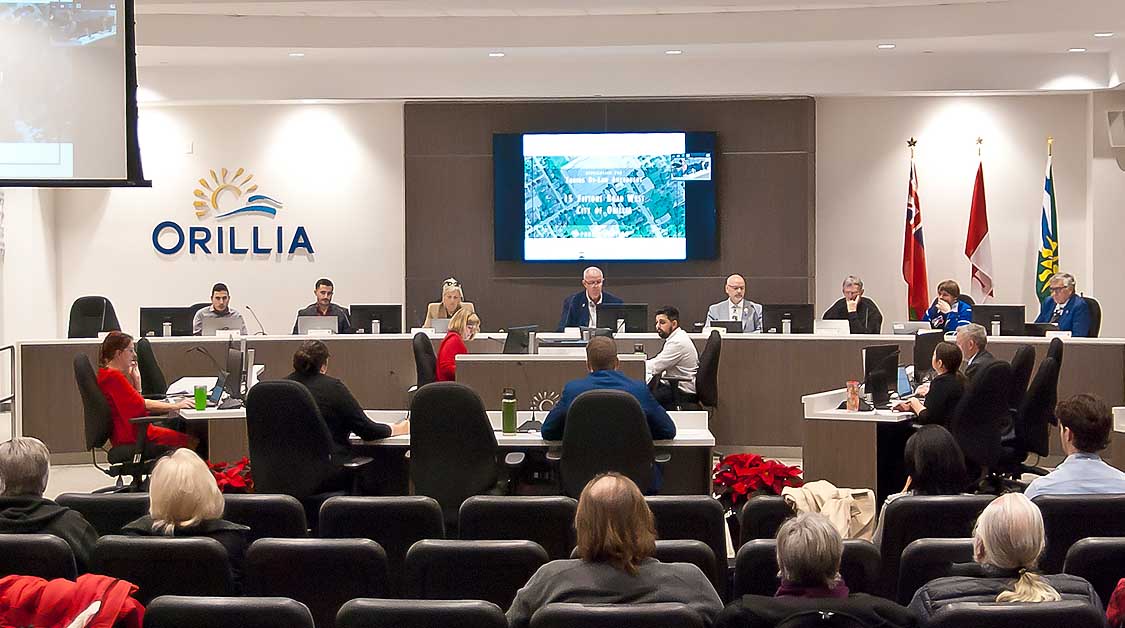
Orillia council’s Monday, May 11, 2 p.m. meeting with the absence of any presentations and deputations, will start with the public forum and then go into a closed session.
The closed session has three items listed. One is to discuss short-term debt capital with Orillia Power Generation Corporation CEO Shaun Hinds. The second is an issue with the Lakehead land development agreement raised by councillor Tim Lauer. And last, to approve additions to various municipal boards and committees.
Help Is On the Way
Back in public the first report is from councillor Whitney Smith which comes with a motion to have staff report on the feasibility of the City creating an emergency response trailer.
Hopefully that also includes a boat on a trailer because the city’s last three emergencies have been because of forms of water – the ice storm, too much snow, too much water when the snow melts.
She is suggesting a 25 foot trailer be organized and equipped with:
- Emergency food supplies and safe drinking water
- Cots, blankets, and basic shelter provisions
- First aid kits and emergency medical supplies
- Flood mitigation equipment (including pumps, hoses, aqua dams,
sandbags, etc.)
- Tools and equipment for debris management and response (including
chainsaws and related safety equipment)
- Supplies and equipment for winter and ice-related emergencies
The motion directs staff to provide costs, where to store a trailer waiting for the next emergency, and what funds might be available from other levels of government.
Can You Pass The Asparagus?
Next is a report from the Orillia food access and sustainability working group who have a report which has a number of recommendations, most important of which is to direct the committee to prepare items for the 2027 budget.
The report will be presented by Jacob Kearey-Moreland and Lesley McMullin of the working group and Charlotte Knegt of the Simcoe Muskoka District Health Unit.
The report provides corroborating documentation used to develop a strategy the committee devised for council to endorse. The recommendations fall under 5 broad categories:
- Food production
- Food infrastructure and the local food economy
- School food and food education
- Food access
- Household food insecurity
The committee calls those pillars and states: “includes strategic pathways that set clear direction for collaboration, policy alignment, and future action planning. These pathways are not an implementation plan or a funding commitment; they reflect where the community is most aligned and where action can make the greatest difference. All five pillars are interconnected and mutually reinforcing, and guided by the priorities of equity, climate and environment, culture and food literacy, Indigenous food sovereignty, and policy.”
The 69 page report reflects consultation with dozens of organizations, including social service agencies, schools, producers, businesses and a review by Dr. Charles Z. Levkoe of Lakehead University and the Canada research chair in equitable and sustainable food systems.
The report points out the City already has some policy and plans cutting across departments and one of the points advocated is coordinating all of it. It also advocates better coordination between social service agencies, government agencies, and every component of the food production sector. Continuing work of the committee, backed by council support of the action plan, will align priorities and actions across multiple jurisdictions and sectors, clarify where collaboration, policy alignment, and advocacy are most needed, and support evidence-based decision making related to food systems.
Much of the document highlights the problems of availability of food, and the cost. As a former economics professor once said, “we don’t have a problem of food shortages, the world has more food than we can eat, we have a distribution problem.”
Money For You, And You, And You
Next is a report outlining grants approved by the grant committee from the City’s grants fund. The fund was originally created to pool and streamline grant requests for Orillia arts and cultural groups, but was expanded from $35,000 to $50,000 and at the same time allowed other community groups to apply for grants. It’s a case of the original intent being supplanted by diluting the field, which could be viewed as make less available to arts and culture, instead of creating another avenue for other kinds of support requests.
With this round only two of the six grants approved to organizations which want to supplement their operating budgets are arts groups. Five of the six are awarded $750. For the arts groups, this represents a drop in general funding supplements which in the past have generally been between $1,000 and $2,000. In fact both arts groups only got half of the amount they requested.
A portion of the grants budget is earmarked for festivals. Of the ten grants approved, only one is to a non-arts or cultural activity. Grant values ranged between $1,500 and $5,000. Only one group, the Ontario Federation of School Athletic Associations got the entirety of what it asked for, $5,000, and in comparison to the other grant requests is the one group that should be most able to afford their activities, in this case a basketball tournament.
The total budget amount for 2026 is $50,000 and if council approves the report, there will be $17,500 left in the account.
Back To Nature
Staff have a report to create a boulevard policy as it relates to property owners planting wild flowers instead of having grass on boulevards. The addition to the clean and clear by-law outlines what property owners can do. One of the points is to not plant ‘noxious weeds, poisonous and invasive plants’. Several are listed, notably Buckthorn.
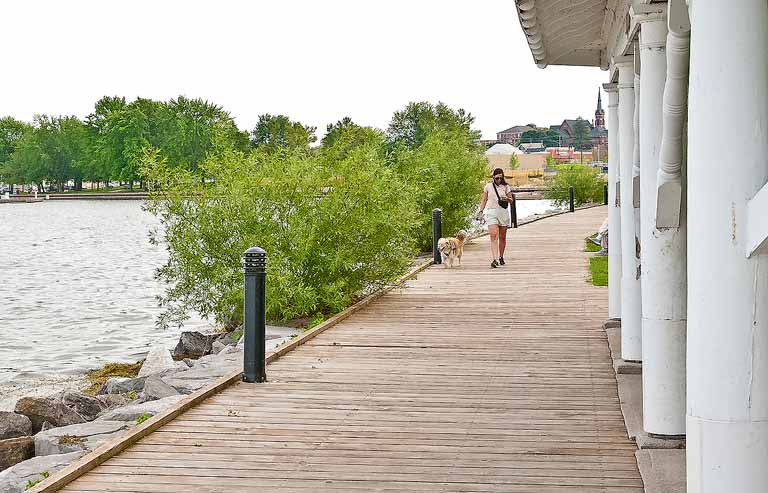
The City might want to take a look at the boardwalk in Couchiching Beach Park which has had several buckthorn plants growing on the shoreline rocks the last two or three years
The policy also outlines what happens when road work affects the carefully kept wildflower gardens some residents have; better coordination with property owners pre-construction and for restoration of a boulevard post-construction.
Watch Your Step
Staff have a report outlining statistical data from the Orillia 2024 Ontario 55+ Winter Games, including revenue. The games made $110K. The profit from the games is to be used to fund other sport, recreation and culture projects. To that end, the recommendation is to pool that amount with a $59K Canada cultural spaces grant for upgrades to the balcony at the Opera House, one component of which is improve lighting.
Urban Renewal
Staff have a report to extend the Downtown Tomorrow Community Improvement Plan to the end of 2028 and to increase amounts available to property owners for making improvements and to develop the plans for those improvements.
The downtown plan expires in 2026. Over the last ten years 54 grants of more than $1 million were awarded for façade improvement and revitalization. This contributed to another $11 million of renovation activity.
The intent of the grant program is to encourage property owners to spruce up the look of their buildings and to make additions to them. Staff say the fund has been under utilized since 2023 and part of that is grant amounts are not great enough to encourage property owners to spend more of their own money.
The fund currently has a balance of $1.3 million and staff are recommending increasing the amount available for feasibility and design studies to $50k from $5K, and increasing the grant availability for making improvements to $100K from $25K.
At the same time staff are also recommending creation of an industrial and commercial development charge grant program on a temporary basis, until the end of the current downtown plan or the money in the reserve runs out. Additions that increase space by less than 50% do not have development charge apply and staff say as an example and addition of more than 50% would degenerate $12K in charges for 1,000 sq. ft.
Thanks For Writing
There are three items on the agenda that have been pulled from council information packages in order for council to direct different action.
Councillor Jay Fallis pulled one relating to the LIV Communities Hawk Ridge Development relating to erosion and sediment control. Their sediment control pond failed into Silver Creek in April and Fallis wants a more detailed report regarding site conditions.
Mayor Don McIsaac pulled a letter asking for Orillia to participate in the annual Moose Hide Day (May 14), a campaign to end violence towards women and children. The letter is dated April 29 and appeared in the May 1 council package. The recommendation is to receive the letter, which means take no action.
Another item pulled by councillor Janet-Lynne Durnford relates to the Orillia Museum of Art and History. OMAH had asked for a deputation, which was rejected, and relates to the lease agreement with the City. Durnford wants the deputation to go ahead. This will be covered in a separate analysis
Motions
There are three enquiry motions. Councillor Smith would like a report on the ‘feasibility, logistical considerations, and associated costs of raising and repaving Victoria Crescent as a result of recent flooding’.
She also has a motion for a report on the ‘feasibility of implementing a by-law or other measures to regulate the feeding of wildlife within the City’.
Councillor Lauer would like a report on the ‘feasibility, cost, and logistics of adding a pump bike park to the Skatepark Project’. This is similar to creating a freestyle skiing course, but for mountain bikes.
Council meetings are open to the public or can be watched on the City’s Youtube channel.
(Photos by Swartz – SUNonline/Orillia)