Editorial: Champlain Is Back, On The Agenda
By John Swartz
Part of Monday, March 30th’s meeting will be spent discussing a report regarding the Champlain monument. The report is authored by Mayor Don McIsaac, and Guy Freedman of First Peoples Group, consultants hired to help the City with restoring the monument in a way that will annoy the least amount of people will be in attendance.
SUNonline/Orillia previously reversed its support to having a modified monument reinstalled in Couchiching Beach Park. The change of opinion is based on information contained in three documents linked in the editorial (which, to get a full picture of our reasoning should be read). In short, Champlain was not a good person. He had his own reasons for his actions and they were not friendly to native communities he encountered. It was learned the main fiction most people around here cling to, that he was nursed back to health as an act of kindness, has two glaring omissions.
One, his wound came from an act of hubris, and two it was found out he was going to visit the Iroquois in upstate New York to form some kind of alliance against the Huron. It appears the Huron knew much more about their long term prospects than subsequent stories told. The Iroquois of the time were not known to be good neighbours to other Native cultures.
Another piece of information was provided indicating the plot the statue occupied, and the new plinth sits on, is the very place colonial government officials informed the chiefs of the various tribes in the area their children would be sent to residential schools. This information came from a reliable source, but SUNonline/Orillia does not possess supporting documentation, though we do have a copy of the minutes of the meeting. On balance, considering the available documented information in total is more correct than convention wisdom has shown to be, this bit of light on the land should be considered in the debate about reinstalling the monument. It would be adding salt to the wounds many people feel regarding the monument; placing it back upon the dirt their children were consigned to lives they didn’t ask for. Removing Champlain and leaving the Native figures on that spot could be viewed as a bit of reclamation.
There are still many people in Orillia who have not taken the time to read the documents, and more importantly listen to their fellow citizens, and cling to a story of how important Champlain was to the area. At best his presence here was a blip in the timeline of history and not really that important and it is greatly sanitized and overblown, though his time in Quebec was much more consequential and detrimental.
This is not to say the people of Orillia of the day were acting nefariously. First they were a product of their times. They knew what they were told to know and the information available was not as thorough as it is today, and society’s conventional view of the world was likely more biased and limited. They thought they were acting in good faith toward the province of Quebec (the monument was not an olive branch, and never was, to our Native cousins). They are not the bad guys in this story; they were ill-informed. It is us who ignore history and charge ahead with a project so divisive that may not be seen in the good light of history.
The report states a survey done in 2019 showed, “70% indicated that their preferred option was to reinstall the monument as it previously existed, with the addition of educational and interpretive elements adjacent to the monument. That’s 70% based on what was known at the time, not reflecting information SUNonline/Orillia found. It is likely the adverse regard for new information wouldn’t change the percentage.
SUNonline/Orillia remains opposed to re-installing the monument, but we also recognize there are some mitigating factors, namely the tide of public opinion to reinstall to be weighed and the political will to bow to the pressure. It may take years and an aggressive campaign to re-educate the public on just who Champlain was. Years to realize putting his statue back would be akin to putting one up memorializing Robert E. Lee, in Washington D.C. Or, erecting one for Jeremy MacKenzie, leader of Diagalon, or Tamara Lich as a great Canadians.
It should be noted the Chippewas of Rama bowed out of the committee to restore the monument long ago (and have refused to rejoin), and both councillors Tim Lauer and Janet-Lynne Durnford have resigned from the most recent version of the committee. The list of groups/people consulted only includes the consultants representing Natives and no other Native groups.
The New Plan
It is a Sisyphean battle to stop this thing, so effort reducing its false historical context and replacing it with something closer to reality is maybe an approach to consider.
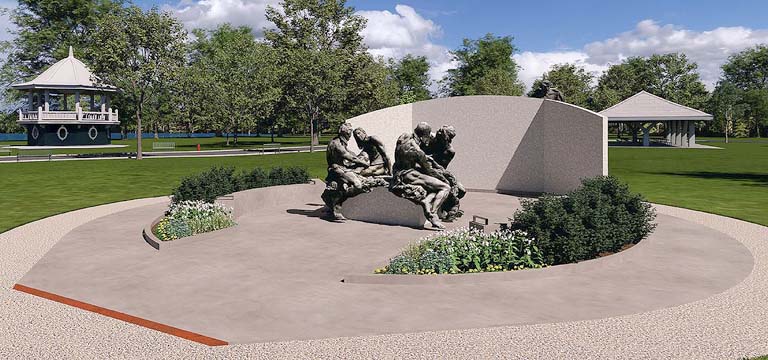
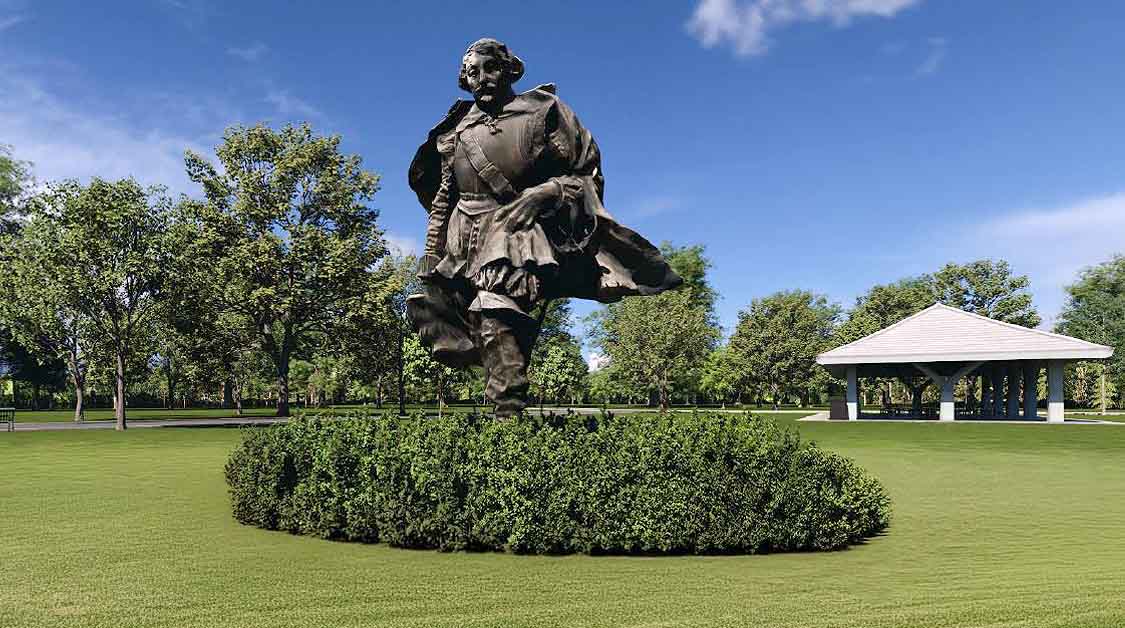
The report to council contains some artist renderings of how the monument pieces might be erected. To us, moving the Champlain figure off the spot and away from the source ground of misery for Natives across this country is a step in the right direction, Not a big enough step, but a step nonetheless.
Creating a separate setting for the Native figures on that ground (which should be accompanied with some explanation of why that ground is important to Native communities) may not have been intentional regarding GPS coordinates, but those who know the stories passed down through generations will get the significance. Indeed the consultant’s statement regarding text to be inscribed on a new backdrop/wall informs reason for breaking the monument up into its parts is:
“The original Samuel de Champlain monument was designed and installed in a different era. The current era requires us to present a more balanced view of the past, one that brings pride to our children and grandchildren. This re-imagined statuary honours the significant contributions of the Chippewas of Rama, the Huron-Wendat and the Anishinaabeg. Placing Samuel de Champlain in the distance behind the centre wall structure and removing the religious figure is a metaphor signaling the desire and need to move forward to a new era of community and friendship.”
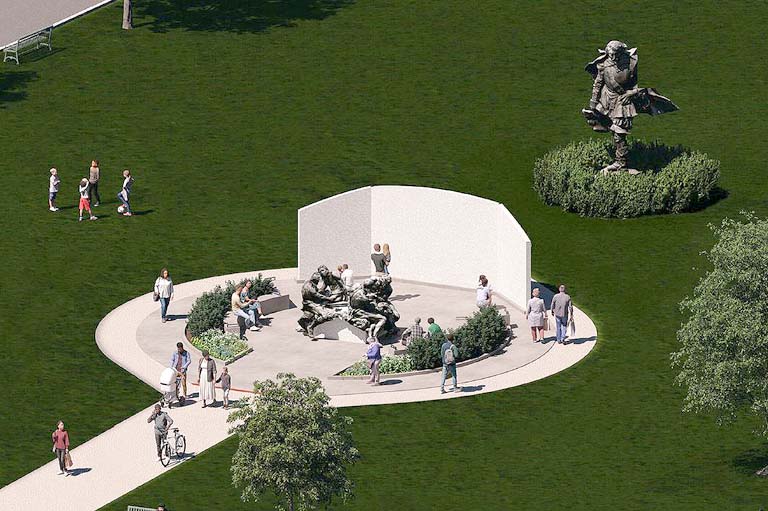
They might want to consider adding something about the dirt beneath their proposal. Any additional pieces will be storyboards in Ojibway, Huron-Wendat, English and French. As one can see from the artist renderings, there also exists an opportunity to have native art etched into a stone wall.
What Is The Value?
Underlying all of this, the sculptures are significant works of art. Vernon March created something very lifelike, maybe the most lifelike since David. One can travel far to find another sculpture of the human form so expertly done.
From a craft perspective the work should be seen and studied for its artistic merit. Some people from across the lake will even concede this point. Aside from the central figure (which would become secondary if the new version prevails) the pieces are of a quality sculptors hope to achieve with their own work.
The question remains, how to present it?
The Wrinkle
The issue which might stall this project is money. The mayor is asking council to approve an additional $700K to the budget of $250K.
The original amount is for the work to date. It is interesting one of the reasons Parks Canada stated for removing the statues was for preservation and restoration. However council’s report references restoration work still needs to be done. One could ask, what restoration work did Parks Canada do? And why is there still more to be done?
The motion also asks for permission for the mayor to, ‘approach the Federal and Provincial Governments, as well as the County of Simcoe and the Townships of Oro-Medonte, Ramara, and Severn, to seek funding for the project’
It also directs the mayor to consult, “with Lakehead University, Georgian College, the Orillia Museum of Art and History, and staff at the Stephen Leacock Museum to discuss improvements to the proposed design concept for the Couchiching Beach Park statuary.” Why wouldn’t that list include Native groups?
Getting the spending approval may be the point that stops this project. Stops at least until Native communities come up with a way to restore the monument. One way might be to move him far away from the park, but it’s likely no Native group will ever support putting it up anywhere in any manner.
If it is restored in the park as drawings suggest, every inch away from its original location will be best. Also it should be a consideration to spot weld his sword in place. We wouldn’t want to mount another dragnet to find it (Champlain lost more than one sword on his journeys).
Council meetings are open to the public or can be watched on the City’s Youtube channel.
(Photos by Swartz – SUNonline/Orillia) Main: Artist’s rendering of a new setting for the Champlain monument.